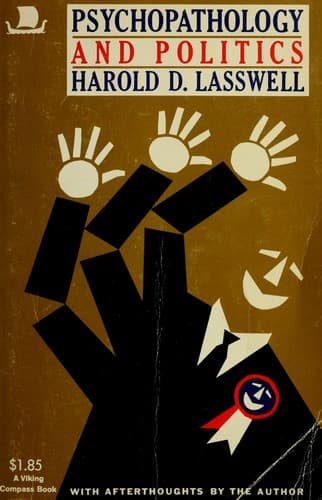
Psychopathology and politicsLasswell, Harold D. (Harold Dwight)
Science
Psychopathology and politics
Lasswell, Harold D. (Harold Dwight)
Personality and politics; Political science; Psychoanalysis; Psychology, Pathological
From what has been said, it is clear that a word like “political” may
be given an “institutional” or a “functional” meaning in a particular
context, and that--and this is the most important consequence--any
contribution to the understanding of the “institutional” process is a
contribution to the understanding of the wider “functional” process,
and the reverse. In this resides the unity of the social sciences. The
apparent disunity arises from the differences in starting-point of
particular inquiries. One begins with a series of phenomena which are
selected from a single institutional process, and another begins with
a series of phenomena which are selected from several institutional
processes according to some functional conception.
This unity of destination and disunity of starting-point is abundantly
manifested in the scientific study of human behavior. The specialist
on some phase of the political process, institutionally conceived,
who is asked to classify the types of political behavior, devises
his categories on the basis of the institutional processes which he
knew best. It would be possible, were it worth the effort, to pass in
review the typologies which have been propounded from time to time
by specialists in executive organization, public administration,
judicial administration, legislation, political parties, propaganda
and conspirative organizations, political revolution, nationalism,
imperialism, interstate methods of adjustment (war, diplomacy,
conference, adjudication, mediation, arbitration), and all the other
topics in political science.
At first glance, the functional method of defining political types
would seem to lead to even greater congeries of categories than the
institutional method. From the functional standpoint politics is found
wherever, to use the older terminology, “wills” are in conflict. This
implies that intensely political manifestations in society are not
confined to government officials and parties, but to banking houses,
manufacturing enterprises, distributing services, ecclesiastical
organizations, fraternal associations, and professional societies.
It is probable that the most aggressive, power-lusting individuals
in modern society find their way into business, and stay out of the
legislature, the courts, the civil service, and the diplomatic service.
If this be true, the student of political personalities will find the
most interesting objects of study in J. P. Morgan and Company, in the
United States Steel Corporation, and among the clerical or educational
or medical politicians.
Public-domain text, read in full here on John Shaqi.
Reviews
Reviews
No reviews yet
Be the first to share your thoughts on this work.
Join the Discussion
Join the discussion
Sign in to leave a comment or review.
Sign InorCreate an account