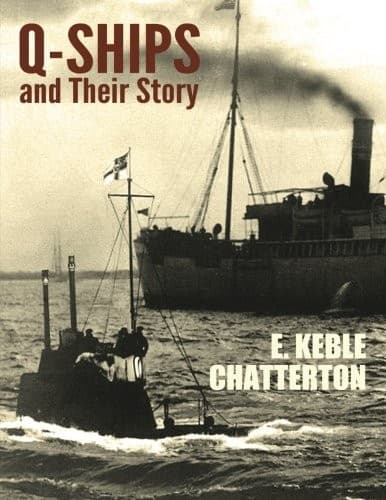
Q-Ships and Their StoryChatterton, E. Keble (Edward Keble)
History
Q-Ships and Their Story
Chatterton, E. Keble (Edward Keble)
Q-ships; World War, 1914-1918 -- Naval operations
resembling anything but a warship. Thus it came about that on January
27, 1915, the second decoy ship was commissioned. This was the Great
Eastern Railway S.S. _Antwerp_ (originally called _Vienna_), which
operated in the English Channel. She was placed under the command of
Lieut.-Commander Godfrey Herbert, R.N., one of the most experienced and
able officers of our submarine service. The choice was a happy one, for
a submarine officer would naturally in his stalking be able to realize
at once the limitations and possibilities of his opponent. It was a
most difficult task, for the U-boats at this time were still very shy,
and only took on certainties. Neither in boats nor in personnel had
Germany yet any to spare, and there were periods when the submarine
campaign fluctuated. Thus, day after day, week after week, went by,
and _Antwerp_ never had any chance. The enemy was now beginning to
operate further afield, and at the end of January, 1915, for the first
time, a U-boat made its way up the Irish Sea as far as off Liverpool,
and then, on February 18, was inaugurated the German Submarine
Blockade. Shipping began to be sunk in various places, but the western
end of the English Channel was now a favourite zone, especially in the
neighbourhood of the Scillies; and it was with the hope of being taken
for a merchant ship that _Antwerp_ had come out from Falmouth and made
her way westward. Thus, on March 12, we see her, about three o’clock
in the afternoon, twelve miles north of the Bishop Rock Lighthouse.
A submarine[1] was sighted steering in a northerly direction for a
steamer on the horizon. Here, at length, was a chance. Twenty minutes
later, _Antwerp_ came up to a sailing ship, and found she had on
board the officers and crew of the Ellerman liner _Andalusian_, which
had been captured and scuttled 25 miles W.N.W. of the Bishop Rock.
_Antwerp_ continued her chase, and got within four miles of the
_Andalusian_, still afloat, but then the submarine dived and was never
sighted again. So _Antwerp_ was never able to sink a submarine, and she
was paid off on April 5, 1915.
During the summer of 1915 there was a small steamer called the _Lyons_,
which one used to see in various naval ports, and under various
disguises. Her primary object was to carry naval stores from one port
to another, but it was always her hope to fall in with a submarine.
I remember seeing her one day alongside Pembroke Naval Dockyard,
painted a certain colour and with one funnel. A little later I saw
her elsewhere with a different coat of paint and a dummy funnel added
to her, so that she resembled an ocean-going tug. _Lyons_ also was
unable to entrap the enemy, and terminated her decoy-ship period at the
beginning of November of the same year.
Public-domain text, read in full here on John Shaqi.
Reviews
Reviews
No reviews yet
Be the first to share your thoughts on this work.
Join the Discussion
Join the discussion
Sign in to leave a comment or review.
Sign InorCreate an account