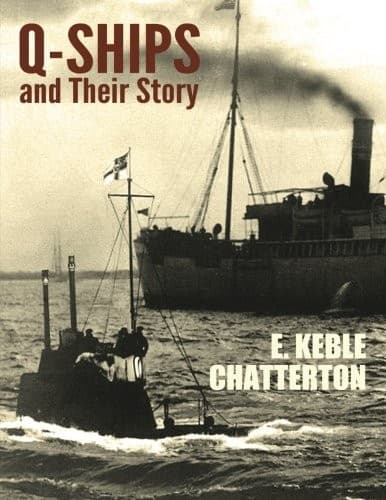
Q-Ships and Their StoryChatterton, E. Keble (Edward Keble)
History
Q-Ships and Their Story
Chatterton, E. Keble (Edward Keble)
Q-ships; World War, 1914-1918 -- Naval operations
Thus the war had gone on for several months, and an apparently sound
idea had failed to produce a single good result. All kinds of shipping
were being sunk, and yet the German submarines somehow could not be
persuaded to attack these disguised ships. How was it? Was there
something in the disguise which gave the steamers away? Was it purely
hard luck? We cannot say definitely, but the fact remained, and it
was rather disappointing. Of course the idea of disguise had been
employed almost from the very first days of the war; for, in August,
1914, Admiral Jellicoe had requested that the armed trawlers, though
commissioned, should not be painted grey like other warships, but
retain their fishing numbers and funnel markings just as in peace time.
In the early summer of 1915, a number of disguised armed trawlers
were also sent out to the Dogger Bank in the hope of catching an
unsuspecting submarine, who might think they were fishing. The idea had
been further developed by a clever scheme involving the co-operation of
a disguised armed trawler towing a submerged British submarine. This
began in May; on June 23 it was the means of sinking U 40, and on July
20 it brought about the loss of U 23; but a few months later this idea
was thought to be played out, and came to an end in October, 1915,
though it was eventually revived in the following summer.
Another variation of the decoy-ship principle at this time was that
employed by Admiral Startin, who was in charge of the naval base at
Granton. In view of enemy submarines having recently held up neutral
merchant steamers in the North Sea, he disguised two big trawlers so
as to resemble small neutral merchant ships. This was in July, 1915.
So successfully was this done that one of them actually deceived
British destroyers, who took her for a Danish cargo steamer. The
next development was further to disguise them by adding a false deck
cargo of timber, boats, and other details, so as to resemble closely
a Norwegian cargo ship, with Norwegian colours hoisted at the mizzen,
two derricks placed on the trawler’s foremast, and Norwegian colours
painted on prepared slips of canvas placed on each side of the hull
amidships. Those who were at sea in those days will recollect that
it was customary for neutral ships to have their national colours
painted on each side of the hull in the hope that the enemy would
not mistake the ships for Allies’. Thus cleverly disguised, the two
Granton trawlers _Quickly_ and _Gunner_ went into the North Sea, armed
with nothing more powerful than a 12-pounder, Admiral Startin being
himself aboard one of the ships. A large submarine was actually sighted
on July 20, and at 1,000 yards the enemy began the action. _Quickly_
thereupon lowered her Norwegian flag, ran up the White Ensign, removed
the painted canvas, replied with her 12-pounder, and then with her
6-pounder. A fine, lucky shot was seen to strike the submarine, and
much smoke was seen to issue.
Public-domain text, read in full here on John Shaqi.
Reviews
Reviews
No reviews yet
Be the first to share your thoughts on this work.
Join the Discussion
Join the discussion
Sign in to leave a comment or review.
Sign InorCreate an account