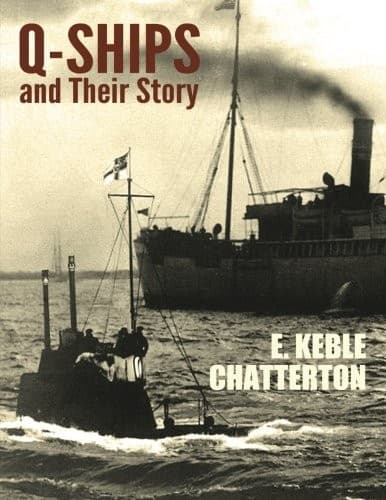
Q-Ships and Their StoryChatterton, E. Keble (Edward Keble)
History
Q-Ships and Their Story
Chatterton, E. Keble (Edward Keble)
Q-ships; World War, 1914-1918 -- Naval operations
Turn your attention back to the autumn of 1914. It was the sinking of
the three _Cressys_ on September 22 by U 9 that taught Germany what a
wonderful weapon of offence she had in the submarine. Five days later
the first German submarine penetrated the Dover Straits. This was
U 18, who actually attacked the light cruiser _Attentive_. But it
was not until October 20 that the first merchant ship, the British
S.S. _Glitra_ in the North Sea, was sunk by a submarine. Six days
later the French S.S. _Amiral Ganteaume_, with Belgian refugees, was
attacked by a German submarine. A month passed, and on November 23
the S.S. _Malachite_ was attacked by U 21, and after being on fire
sank. Three days later the S.S. _Primo_ was sunk also by U 21. It was
thus perfectly clear that we had before us a most difficult submarine
campaign to contend with, and that merchant ships would not be immune.
On the last day of October H.M.S. _Hermes_ was torpedoed off Calais,
and on November 11 H.M.S. _Niger_ had a similar fate near Deal.
[Illustration: COMMANDER S. C. DOUGLAS, R. N.
When serving in the Q-ship “Antwerp,” wearing a false moustache and
disguised as an English commercial traveller.]
[Illustration: COMMANDER G. HERBERT, D.S.O., R.N.
Taken on the bridge of the Q-ship “Antwerp,” disguised as a Dutch pilot
with a wig.
To face p. 8]
What was to be done? The creation of what eventually became known as
the Auxiliary Patrol, with its ever increasing force of armed yachts,
trawlers, drifters, and motor craft; the use of destroyers and our own
submarines formed part of the scheme. But even at this early stage
the Q-ship idea came into being, though not actually under that name.
Officially she was a special-service ship, whose goings and comings
were so mysterious that even among service men such craft were spoken
of in great secrecy as mystery ships. This first mystery ship was the
S.S. _Vittoria_, who was commissioned on November 29, 1914. She had
all the appearance of an ordinary merchant ship, but she was armed,
and went on patrol in the area where submarines had been reported. It
was an entirely novel idea, and very few people knew anything about
her. She never had any luck, and was paid off early in January, 1915,
without ever having so much as sighted a submarine. The idea of decoy
ships suggested itself to various naval officers during December,
1914, and their suggestions reached the Admiralty. The basic plan
was for the Admiralty to take up a number of merchantmen and fishing
craft, arm them with a few light quick-firing guns, and then send them
forth to cruise in likely submarine areas, flying neutral colours.
This was perfectly legitimate under International Law, provided that
before opening fire on the enemy the neutral colours were lowered and
the White Ensign was hoisted. Seeing that the enemy was determined
to sink merchantmen, the obvious reply was to send against them
armed merchantmen, properly commissioned and armed, but outwardly
Public-domain text, read in full here on John Shaqi.
Reviews
Reviews
No reviews yet
Be the first to share your thoughts on this work.
Join the Discussion
Join the discussion
Sign in to leave a comment or review.
Sign InorCreate an account