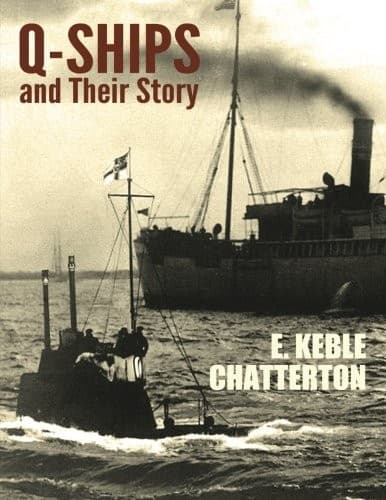
Q-Ships and Their StoryChatterton, E. Keble (Edward Keble)
History
Q-Ships and Their Story
Chatterton, E. Keble (Edward Keble)
Q-ships; World War, 1914-1918 -- Naval operations
Although the enemy made off and was not
sunk, yet it showed that it was possible to fool German submarines by
this disguise. The decoy-ship idea was not merely sound in principle,
but it was practicable and was capable of being used as a valuable
offensive weapon. Most of a year had passed since the beginning of
war, and there were no decoy ship results to show except those which
had been obtained by British submarines working in conjunction with
disguised trawlers. However, just as the seaman often finds the dawn
preceded by a calm and followed by a breeze, so it was to be with
the decoy ships. The dawn of a new period was about to take place,
and this was followed by such a wind of events that if anyone had
dared to doubt the value of this specialized naval warfare it was not
long before such hesitation vanished. Disguised trawlers had in the
meantime been further successful, but there were obviously greater
possibilities for the disguised merchant ship, the collier and tramp
types especially. But this all depended on three things: First, the
right type of ship had to be selected very carefully and with regard to
the trade route on which she would normally in the present conditions
be likely to be found. For instance, it would have been utterly foolish
to have sent a P. and O. liner to cruise up and down the waters of the
Irish Channel or an Atlantic liner up and down the North Sea. Secondly,
having once selected the right ship, much depended on the dock-yard
authorities responsible for seeing that she was fitted out adequately
as to her fighting capabilities, yet externally never losing any of
her essential mercantile appearance. This meant much clever designing,
much engineering and constructive skill, and absolute secrecy. Thirdly,
the right type of keen, subtle, patient, tough officer had to be
found, full of initiative, full of resource, with a live, eager crew.
Slackers, ‘grousers,’ and ‘King’s-hard-bargains’ were useless.
[Illustration: Q-SHIP “ANTWERP”
Showing the collapsible dummy life-raft which concealed the two
12-pounders.]
[Illustration: GUN’S CREW OF Q-SHIP “ANTWERP”
Gun’s crew of “Antwerp” ready to fire on a submarine. The sides of the
dummy life-raft have been collapsed to allow gun to come into action.
To face p. 12]
[Footnote 1: This was U 29, which on March 18 was sunk in the North
Sea by H.M.S. _Dreadnought_.]
CHAPTER II
THE BEGINNING OF SUCCESS
Public-domain text, read in full here on John Shaqi.
Reviews
Reviews
No reviews yet
Be the first to share your thoughts on this work.
Join the Discussion
Join the discussion
Sign in to leave a comment or review.
Sign InorCreate an account