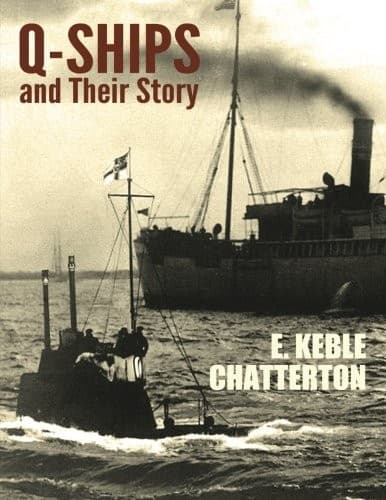
Q-Ships and Their StoryChatterton, E. Keble (Edward Keble)
History
Q-Ships and Their Story
Chatterton, E. Keble (Edward Keble)
Q-ships; World War, 1914-1918 -- Naval operations
We turn now to the northern mists of the Orkneys, where the comings
and goings of the Grand Fleet were wrapped in mystery from the eyes
of the world. In order to keep the fleet in stores—coal, oil, gear,
and hundreds of other requisite items—small colliers and tramp
steamers brought their cargoes northward to Scapa Flow. In order to
avoid the North Sea submarines, these coal and store ships used the
west-coast passage as much as possible. Now, for that reason, and also
because German submarines were already proceeding in earnest, via the
north-west of Scotland, to the south-west Irish coast, ever since the
successful sinking of the _Lusitania_, it was sound strategy on our
part to send a collier to operate off the north-western Scottish coast.
That is to say, these looked the kinds of ships a suspecting U-boat
officer would expect to meet in that particular locality.
Under the direction of Admiral Sir Stanley Colville, a handful of
these little ships was, during the summer of 1915, being fitted out
for decoy work. One of these was the collier S.S. _Prince Charles_, a
little vessel of only 373 tons. In peace-time she was commanded by her
master, Mr. F. N. Maxwell, and manned by five deckhands, two engineers,
and two firemen. These men all volunteered for what was known to be
a hazardous job, and were accepted. In command was placed Lieutenant
Mark Wardlaw, R.N., and with him went Lieutenant J. G. Spencer, R.N.R.,
and nine active-service ratings to man the guns and use the rifles.
She carried the weakest of armament—only a 3-pounder and a 6-pounder,
with rifles forward and aft. Having completed her fitting out with
great secrecy, the _Prince Charles_ left Longhope in the evening of
July 21 with orders to cruise on routes where submarines had recently
been seen. Proceeding to the westward at her slow gait, she saw very
few vessels until July 24. It was just 6.20 p.m. when, about ten miles
W.N.W. of North Rona Island, she sighted a three-masted vessel with one
funnel, apparently stopped. A quarter of an hour later she observed a
submarine lying close to the steamer. Here was the steel fish _Prince
Charles_ was hoping to bait.
Public-domain text, read in full here on John Shaqi.
Reviews
Reviews
No reviews yet
Be the first to share your thoughts on this work.
Join the Discussion
Join the discussion
Sign in to leave a comment or review.
Sign InorCreate an account