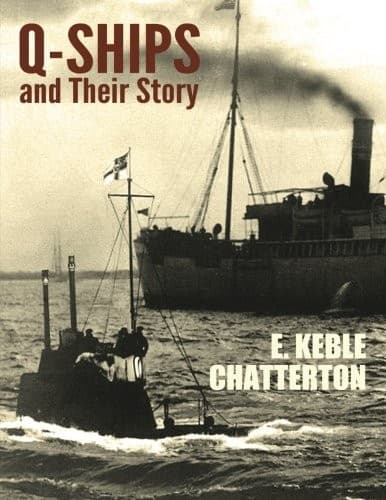
Q-Ships and Their StoryChatterton, E. Keble (Edward Keble)
History
Q-Ships and Their Story
Chatterton, E. Keble (Edward Keble)
Q-ships; World War, 1914-1918 -- Naval operations
Pretending not to see the submarine, and keeping on her course like a
real collier, Lieutenant Wardlaw’s ship jogged quietly along, but he
was closing up his gun’s crews behind their screens and the mercantile
crew were standing by ready to hoist out the ship’s boats when
required. The German now started up his oil-engines and came on at full
speed towards the _Prince Charles_. It had just gone seven o’clock and
the submarine was 3 miles off. The collier had hoisted her colours and
the enemy was about five points on the bow when a German shell came
whizzing across. This fell 1,000 yards over. Lieutenant Wardlaw now
stopped his engines, put his ship head on to the Atlantic swell, blew
three blasts, and then ordered the crew to get the boats out, in order
to simulate the movements of an ordinary merchant ship in the presence
of an attacking submarine.
In the meantime the enemy was approaching rapidly and fired a second
shot, which fell between the funnel and the foremast, but landed 50
yards over. When the range was down to 600 yards the enemy turned her
broadside on to the collier and continued firing; and this was now
the time for the Q-ship’s captain to make the big decision. Should he
maintain his pretence and continue to receive punishment, with the
possibility of losing ship and lives in the hope that the submarine
would come nearer? Or should he reveal his identity and risk everything
on the chance of winning all? This was always the critical moment when
the Q-ship captain held in his judgment the whole fate of the fight, of
the ship, and his men.
Lieutenant Wardlaw, seeing that the enemy could not be enticed to
come any nearer, took the second alternative, and opened fire with
his port guns. The effect of this on the German was remarkable and
instantaneous; for her gun’s crew at once deserted the gun and darted
down into the conning-tower. But whilst they were so doing, one of
_Prince Charles’s_ shells struck the submarine 20 feet abaft the
conning-tower. The enemy then came round and showed her opposite
broadside, having attempted to dive. She now began to rise again as the
collier closed to 300 yards, and frequent hits were being scored by
the British guns. By this time the surprised Germans had had more than
enough, and were observed to be coming out of the conning-tower, whilst
the submarine was settling down by the stern. Still the British fire
continued, and when the submarine’s bows were a long way out of the
water, she took a sudden plunge and disappeared. A large number of men
were then seen swimming about, and the _Prince Charles_ at once made
every effort to pick them up, fifteen officers and men being thus saved
out of thirty-three.
Public-domain text, read in full here on John Shaqi.
Reviews
Reviews
No reviews yet
Be the first to share your thoughts on this work.
Join the Discussion
Join the discussion
Sign in to leave a comment or review.
Sign InorCreate an account