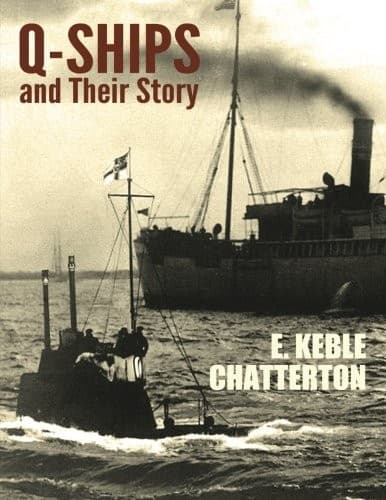
Q-Ships and Their StoryChatterton, E. Keble (Edward Keble)
History
Q-Ships and Their Story
Chatterton, E. Keble (Edward Keble)
Q-ships; World War, 1914-1918 -- Naval operations
Adventures are to the adventurous. In less than a month from this
event _Farnborough_ was again engaged with a submarine, under
circumstances more difficult than the last. One who was present at
the engagement described it to me, and though the submarine managed
afterwards to reach Germany, she was wounded, and only just escaped
total destruction. However, this in no way detracts from the merits of
the story, which is as follows: The scene was similar to that of the
previous incident, the exact position being Lat. 51.57 N., Long. 11.2
W.—that is to say, off the west coast of Ireland. The time was 6.30
in the afternoon of April 15, 1916, and _Farnborough_ was proceeding
northward, doing 5 knots, for Commander Campbell was hoping to
intercept a German submarine which had been reported off the Orkneys on
the 13th, and was probably coming down the west Irish coast.
At the time mentioned the sea was calm and it was misty, but about two
miles off on the starboard quarter could be seen a steamer. Suddenly,
without warning, between the two ships a submarine broke surface,
but Commander Campbell pretended to ignore her until she hoisted the
international signal TAF (‘Bring your papers on board’). Owing to
the mist it was impossible to distinguish the flags clearly enough
to read them. However, Commander Campbell stopped his ship like a
terrified tramp, blew off steam, but quietly kept her jogging ahead
so as to edge towards the enemy and avoid falling into the trough of
the heavy Atlantic swell. There was the submarine lying full length
on the surface, about 300 feet long, with a very large conning-tower
amidships, one gun forward, one aft, and most of the hull painted a
light grey. In reply to the German’s signal _Farnborough_ now kept
her answering pennant at the dip and hoisted ‘Cannot understand your
signal.’ All this delay was valuable to the Q-ship, for it allowed her
to close the range stealthily; and now the submarine also came closer,
with her foremost gun already manned. In the meantime, the ‘tramp’ did
what she was expected to do—hoisted the signal ‘I am sending boat with
ship’s papers,’ and at the same time the bridge boat was turned out
(again in command of Sub-Lieutenant J. S. Smith, R.N.R.), and Commander
Campbell was seen to hand his papers to this officer to take over to
the submarine. It was now 6.40 p.m., and the German fired a shot which
passed over the ship, doing no direct harm, but incidentally spoiling
the whole affair. The best laid schemes of Q-ship captains, and the
most efficient crews, occasionally go astray. One of _Farnborough’s_
people, hearing this gun, thought that _Farnborough_ had opened fire,
so accordingly fired also. It was unfortunate, but there it was. This
mistake forced Commander Campbell’s hand; he at once hoisted the White
Ensign and gave the general order to fire. The range was now about
1,000 yards, and he proceeded at full speed so as to bring his after
Public-domain text, read in full here on John Shaqi.
Reviews
Reviews
No reviews yet
Be the first to share your thoughts on this work.
Join the Discussion
Join the discussion
Sign in to leave a comment or review.
Sign InorCreate an account