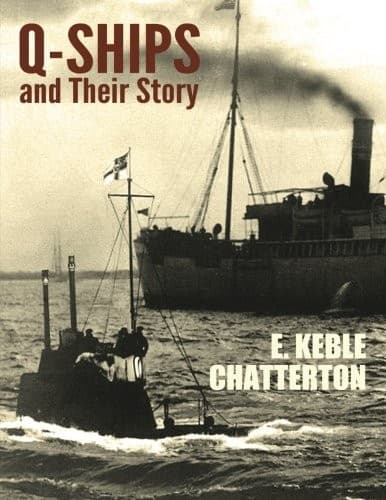
Q-Ships and Their StoryChatterton, E. Keble (Edward Keble)
History
Q-Ships and Their Story
Chatterton, E. Keble (Edward Keble)
Q-ships; World War, 1914-1918 -- Naval operations
gun to bear, the ships becoming about in this position:
[Illustration: FIG. 5.—DIAGRAM TO ILLUSTRATE APPROXIMATE POSITIONS OF
‘FARNBOROUGH’ AND SUBMARINE IN THE ACTION OF APRIL 15, 1916.]
The enemy had been about a point before the _Farnborough’s_ starboard
beam, but when the action commenced the former had been brought
successfully on the beam. The Q-ship’s 12-pounders quickly got off a
score of rounds, accompanied by the 6-pounder and the Maxim and rifles.
Quite early the enemy became damaged, and eventually she submerged
under the screen of smoke, a remarkably near escape which must have
made a great impression on her crew. After dropping depth charges,
_Farnborough_ closed the strange steamer which had been stopped about
500 yards off, and found her to be the Dutch S.S. _Soerakarta_. With
true seamanlike chivalry the Dutch captain, pitying the shabby-looking
tramp steamship, actually offered Commander Campbell assistance.
This neutral was bound from the Dutch East Indies to Rotterdam, via
Falmouth and Kirkwall, and on sighting him the submarine had hoisted
the usual ‘Bring your papers on board.’ The Dutchman had just lowered
his boat, and was about to row off to the German, when up came the
unkempt collier _Farnborough_ with a white band on her funnel, and
then, to the amazement of all beholders, from her blazed shell after
shell. It was a splendid free show, and one shell was distinctly seen
to hit the conning-tower. Two miles away from the scene was the armed
trawler _Ina Williams_ on patrol, and as soon as she heard the firing
she went to action stations and came along at full speed. Ten minutes
later she felt a couple of shocks, so that her captain thought she had
struck something. These were, in fact, the concussions of the two depth
charges which _Farnborough_ had dropped.
If the submarine had escaped, at least he would be able to warn his
superiors at home that they could never tell the difference between a
‘trap-ship’ and a genuine merchantman, and it would be safer not to
attack steamers unless they were perfectly sure. During the rest of
that year Commander Campbell continued to cruise in _Farnborough_, but
the summer and autumn passed and no further luck offered itself.
Winter followed and was almost merging into spring, and then again this
ship made history. In another chapter this thrilling episode will be
told. In the meantime much else had happened.
Public-domain text, read in full here on John Shaqi.
Reviews
Reviews
No reviews yet
Be the first to share your thoughts on this work.
Join the Discussion
Join the discussion
Sign in to leave a comment or review.
Sign InorCreate an account