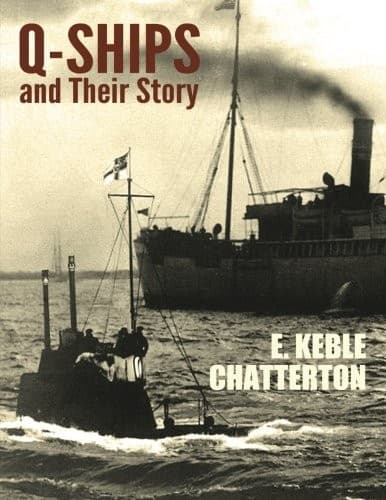
Q-Ships and Their StoryChatterton, E. Keble (Edward Keble)
History
Q-Ships and Their Story
Chatterton, E. Keble (Edward Keble)
Q-ships; World War, 1914-1918 -- Naval operations
There can be no doubt but that these sailing ships had the most
strenuous and arduous task of all. They suffered by being so useful,
for the Q-steamships, as a rule, did not spend more than eight days
at sea out of twelve, and then they had to come in for coal. The
schooners, as we have seen, could keep the sea for a month, so long
as they had sufficient water and provisions. Several more were added
to the list during 1917 and 1918, and there was never any lack of
volunteers for them. The only difficulty was, in these days of steam,
in choosing those who had had experience in sailing craft. The revival
of the sailing man-of-war was certainly one of the many remarkable
features in the naval campaign.
CHAPTER VII
MORE SAILING SHIPS
During the ensuing months many demands were made on the sailing-ship
man-of-war. There were pressed into the service such vessels as the
schooner _Result_, the 220-ton lugger _Bayard_, the three-masted
schooner _Prize_, the motor drifter _Betsy Jameson_, the ketch _Sarah
Colebrooke_, the auxiliary schooner _Glen_ (alias _Sidney_), the
brigantine _Dargle_, the _Brown Mouse_ yacht, built on the lines of a
Brixham trawler, and so on. The barquentine _Merops_, otherwise known
as _Maracaio_ and Q 28, began decoy work in February, 1917. She was
fitted out in the Firth of Forth with a couple of 12-pounders and
a 4-inch gun. At the end of May she had a severe engagement with a
submarine, and was considerably damaged aloft. In March the 158-ton
Rye motor ketch _Sarah Colebrooke_ was requisitioned, and sent to
Portsmouth to be fitted out, appearing in May as the _Bolham_. A
month later, 20 miles south of Beachy Head, she fought a submarine,
and had quite an unpleasant time. One of the enemy’s shells exploded
under the port quarter, lifting the ketch’s stern high out of the
water, another exploded under the port leeboard, sending a column of
water on board, and swamping the boat; whilst a third burst on board,
doing considerable damage. She fought the submarine until the latter
disappeared, but the _Bolham’s_ motor was by this time so choked with
splinters and glass that she could not proceed to the spot where the
submarine had last been seen, and of course it so happened that there
was no wind.
Public-domain text, read in full here on John Shaqi.
Reviews
Reviews
No reviews yet
Be the first to share your thoughts on this work.
Join the Discussion
Join the discussion
Sign in to leave a comment or review.
Sign InorCreate an account