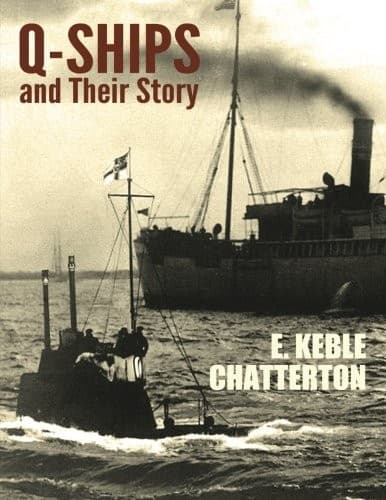
Q-Ships and Their StoryChatterton, E. Keble (Edward Keble)
History
Q-Ships and Their Story
Chatterton, E. Keble (Edward Keble)
Q-ships; World War, 1914-1918 -- Naval operations
On June 8 four fishing smacks were captured and sunk off the Start in
full view of the Q-smack _Prevalent_, a Brixham trawler armed with
a 12-pounder. Again it happened to be a calm, so _Prevalent_, being
too far away, was unable to render assistance. After this incident
it was decided to fit an auxiliary motor in the trawler-yacht _Brown
Mouse_, which was doing similar service and was specially suitable
for an engine. On the following day our friend _Helgoland_ had
another encounter, this time off the north coast of Ireland, the
exact spot being 8 miles N. by W. of Tory Island. The fight began at
7.25 a.m., and half an hour later the submarine obtained a direct hit
on the after-gun house of the brigantine, killing one man, wounding
four ratings, and stunning the whole of the after-guns’ crews. But
_Helgoland_, with her charmed life, was not sunk, and she shelled the
submarine so fiercely that the U-boat had to dive and disappear.
Even a private yacht was taken up for this work in June. This was the
116-ton topsail schooner _Lisette_, which had formerly belonged to
the Duke of Sutherland. She had been built as far back as 1873 with a
standing bowsprit and jibboom. She was taken from Cowes to Falmouth,
where she was commissioned in August, and armed with three 6-pounders.
But this old yacht was found to leak so much through her seams, and
her construction was so light, that she was never a success, and
was paid off in the following spring. In April, 1917, the auxiliary
schooner _Sidney_ (alias _Glen_) began service as a decoy, having been
requisitioned from her owners and fitted out at Portsmouth. A crew was
selected from the Trawler Reserve, but the guns’ crews were naval.
Armed with a 12-pounder and a 3-pounder, she was fitted with wireless,
and cruised about in the English Channel, her complement consisting
of Lieutenant R. J. Turnbull (R.N.R.), in command, one sub-lieutenant
(R.N.R.), one skipper (R.N.R.), two R.N.R. seamen, one R.N.R. stoker to
run the motor, a signal rating, a wireless operator, four R.N. ratings
for the big gun, and three for the smaller one. During the afternoon of
July 10, 1917, _Glen_ was in combat with a submarine of the UC type,
and had lowered her boat in the customary manner. A German officer from
the conning-tower hailed the boat, and in good English ordered her to
come alongside. This was being obeyed, when something seemed to startle
the officer, who suddenly disappeared into the conning-tower, and the
submarine began to dive. _Glen_ therefore opened fire, and distinctly
saw two holes abaft the conning-tower as the UC-boat rolled in the
swell. She was not seen again, and the Admiralty rewarded _Glen’s_
captain and Sub-Lieutenant K. Morris, R.N.R., with a D.S.C. each.
Public-domain text, read in full here on John Shaqi.
Reviews
Reviews
No reviews yet
Be the first to share your thoughts on this work.
Join the Discussion
Join the discussion
Sign in to leave a comment or review.
Sign InorCreate an account