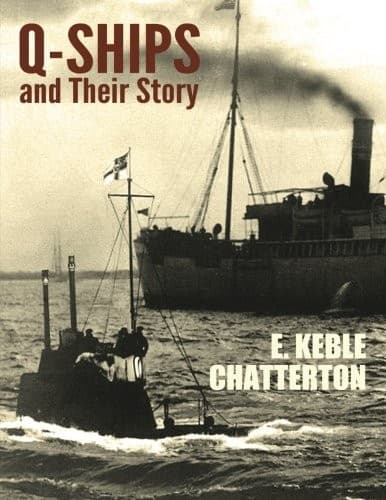
Q-Ships and Their StoryChatterton, E. Keble (Edward Keble)
History
Q-Ships and Their Story
Chatterton, E. Keble (Edward Keble)
Q-ships; World War, 1914-1918 -- Naval operations
During the month of January, 1917, the naval base at Lowestoft called
for volunteers for work described as ‘dangerous, at times rather
monotonous, and not free from discomfort.’ Everyone, of course, knew
that this meant life in a Q-ship. The vessel selected was the 122-ton
three-masted topsail schooner _Result_, which was owned at Barnstaple,
and had in December come round to Lowestoft from the Bristol Channel.
Here she was fitted out and commissioned at the beginning of February,
being armed with a couple of 12-pounders, but also with torpedo-tubes.
As a sailing craft she was slow, unhandy, and practically unmanageable
in light winds. At the best she would lie no nearer to the wind than
5-1/2 points, and in bad weather she was like a half-tide rock. True,
she had a Bolinders motor, but the best speed they could thus get out
of her was 2-1/2 knots. The result was that her officers had great
difficulty in keeping her out of the East Coast minefields, and did
not always succeed. She took in 100 tons of sand as ballast, and a
rough cabin was fashioned out of the hold for the two officers. In
command was appointed Lieutenant P. J. Mack, R.N. (retired), a young
officer who had seen service at the Dardanelles in the battleship
_Lord Nelson_ and in the historic _River Clyde_, whence he had been
invalided home. As he was not an expert in the art of sailing, there
was selected to accompany him as second in command Lieutenant G.
H. P. Muhlhauser, R.N.R., who was not a professional seaman, but a
keen amateur yachtsman of considerable experience, who had made some
excellent cruises in his small yacht across the North Sea and had
passed the Board of Trade examination as master of his own yacht. The
sailing master who volunteered was an ex-schooner sailor, and her mate
also was an old blue-water seaman. The motor man was a motor mechanic
out of one of the Lowestoft M.L.’s, and there was a trimmer from the
Trawler Reserve. She carried also a wireless operator, a cook, a
chief petty officer, deckhands, and some Royal Naval ratings for the
armament. All the crew, consisting of twenty-two, had seen considerable
service during the war in various craft, and one of the deckhands
was in the drifter _Linsdell_, which was blown up on an East Coast
minefield at the commencement of the war. He had been then picked up
by H.M.S. _Speedy_, who in turn was immediately blown up. This man
survived again, and was now a volunteer in a Q-ship. _Result’s_ crew
were trained to go to their ‘panic stations’ at the given signal, when
the bulwarks were let down and the tarpaulins removed from the guns,
the engineer on those occasions standing at the hatchway amusingly
disguised as a woman passenger, arrayed in a pink blouse and a
tasselled cap which had been kindly provided by a lady ashore.
Public-domain text, read in full here on John Shaqi.
Reviews
Reviews
No reviews yet
Be the first to share your thoughts on this work.
Join the Discussion
Join the discussion
Sign in to leave a comment or review.
Sign InorCreate an account