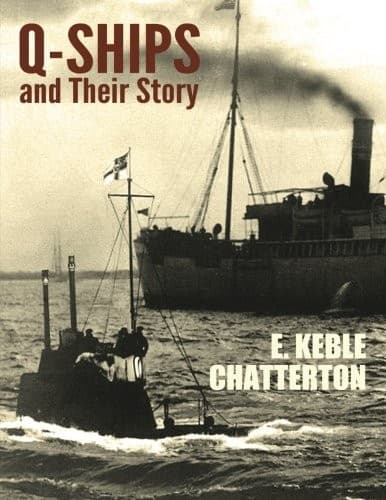
Q-Ships and Their StoryChatterton, E. Keble (Edward Keble)
History
Q-Ships and Their Story
Chatterton, E. Keble (Edward Keble)
Q-ships; World War, 1914-1918 -- Naval operations
then, one may definitely assert, you have in you much that goes to the
making of an ideal Q-ship captain and a brave warrior. As such you
might make a first-class commanding officer of a destroyer, a light
cruiser, or even a battleship; but something more is required. The
enemy is artful; you must be super-artful. You must be able to look
across the tumbling sea into his mind behind the conning tower. What
are his intentions? What will be his next move? Take in by a quick
mental calculation the conditions of wind, wave, and sun. Pretend to
run away from him, so that you get these just right. Put your ship
head on to sea, so that the enemy with his sparse freeboard is being
badly washed down and his guns’ crews are thinking more of their
wet feet and legs than of accurate shooting. Then, when you see him
submerging, alter course quickly, reckon his probable position by the
time you have steadied your ship on her course, and drop a series of
depth-charges over his track. ‘If you can fill the unforgiving minute
with sixty seconds’ worth of distance, run’; if you have acted with
true seamanship and sound imagination, you will presently see bits of
broken wreckage, the boil of water, quantities of oil, perhaps a couple
of corpses; and yours is the U-boat below, my son, and a D.S.O.; and a
thousand pounds in cash to be divided amongst the crew; and you’re a
man, my son!
That, in a few phrases, is the kind of work, and shows the
circumstances of the Q-ship in her busiest period. As we set forth
her wonderful story, so gallant, so sad, so victorious, and yet so
nerve-trying, we shall see all manner of types engaged in this great
adventure; but we cannot appreciate either the successes or losses
until we have seen the birth and growth of the Q-ship idea. As this
volume is the first effort to present the subject historically, we
shall begin at the beginning by showing the causes which created
the Q-ship. We shall see the consecutive stages of development and
improvement, the evolution of new methods, and, indeed we may at once
say it, of a new type of super-seamen. How did it all begin?
[Illustration: AN EARLY Q-SHIP
Q-ship “Antwerp” entering Harwich harbour.]
[Illustration: Q-SHIP “ANTWERP”
Commander Herbert is on the port side of the bridge, the Mercantile
Chief Officer and Quartermaster being in the foreground.
To face p. 6]
Public-domain text, read in full here on John Shaqi.
Reviews
Reviews
No reviews yet
Be the first to share your thoughts on this work.
Join the Discussion
Join the discussion
Sign in to leave a comment or review.
Sign InorCreate an account