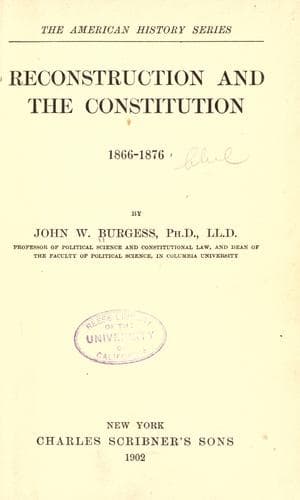
Reconstruction and the Constitution, 1866-1876Burgess, John William
History
Reconstruction and the Constitution, 1866-1876
Burgess, John William
Reconstruction (U.S. history, 1865-1877); United States -- Politics and government -- 1865-1877
There is no doubt that the Sumner-Shellabarger theory of Reconstruction
was correct. The only question was how exacting Congress would be in
realizing it. Under such a situation it behooved the President to act
with great caution and moderation, and to do nothing to provoke a
conflict in which he was certain to be worsted. And it also behooved
the people of the South to make no opposition to the bestowal of a
large measure of civil liberty upon the freedmen, nor to such an
adjustment of the basis of political representation as would not
necessitate negro suffrage, and not to insist upon sending to Congress,
at the outset, the men who had made themselves particularly obnoxious
to loyal feeling. How both the President and the persons in authority
at the South disregarded these considerations of prudence, and how the
position assumed by them upon these subjects drove Congress into more
and more radical lines, is the further subject of the next three
chapters.
{62}
CHAPTER V
THE CONGRESSIONAL PLAN (_Continued_)
The Freedmen Codes in the South--The Reports of Grant and Schurz in
Regard to the Status in the South--The Freedmen's Bureau Bill of
1866--The President's 22d of February Speech--The Civil Rights
Bill--The Veto of the Bill--The Veto Overridden--The Fourteenth
Amendment--The Discussion of the Propositions in Congress--The
President's Attitude toward the Proposed Amendment--Mr. Seward's Acts
in Regard to Ratification--The Requirement that the Ratification of the
Proposed Amendment should be the Condition of the Admission of the
Senators- and Representatives-elect to Seats in Congress--The Tennessee
Precedent.
[Sidenote: The Freedmen codes in the South.]
We have reviewed the acts of the new legislature of Mississippi
concerning the civil status of the freedmen. It is sufficient to say
that during the winter of 1865-66, the other reconstructed legislatures
followed the example of the legislature of Mississippi. These movements
forced upon the Republican party in Congress the conviction that the
civil rights of the freedmen must be secured by national law. As yet
there existed only the Thirteenth Amendment to the Constitution upon
which to base Congressional statutes, and this, as we know, simply
abolished and prohibited slavery and involuntary servitude, and
empowered Congress to pass appropriate laws for the execution of the
Amendment. By virtue of the war powers still exercised by the
Administration several of the Union Generals, as we shall see, had set
aside this legislation in {63} some of these reconstructed "States."
But, of course, it was well understood that this was only a temporary
remedy. During the month of January, 1866, the Republicans in Congress
became convinced that the newly organized "States," with the exception
of Tennessee, were consciously developing freedmen's codes which would
not differ greatly from their old slave codes.
[Sidenote: The reports of Grant and Schurz in regard to the status in
the South.]
Public-domain text, read in full here on John Shaqi.
Reviews
Reviews
No reviews yet
Be the first to share your thoughts on this work.
Join the Discussion
Join the discussion
Sign in to leave a comment or review.
Sign InorCreate an account