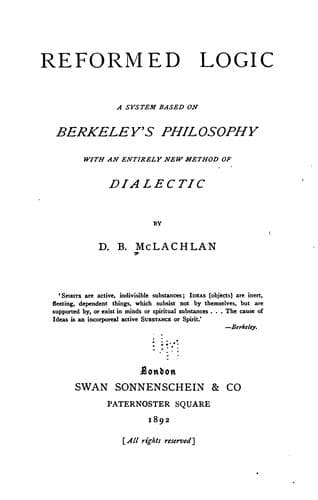
Reformed Logic: A System Based on Berkeley's Philosophy with an Entirely New Method of DialecticMcLachlan, D. B.
Philosophy
Reformed Logic: A System Based on Berkeley's Philosophy with an Entirely New Method of Dialectic
McLachlan, D. B.
Logic
'If we speak of the Mind as a series of feelings, we are
obliged to complete the statement by calling it a series of
feelings which is aware of itself as past and future: and we
are reduced to the alternative of believing that the Mind, or
Ego, is something different from any series of feelings,
or possibilities of them, or of accepting the paradox that
something which _ex hypothesi_ is but a series of feelings,
can be aware of itself as a series.
'The truth is that we are here face to face with that final
inexplicability at which, as Sir W. Hamilton observes, we
inevitably arrive when we reach ultimate facts; and in general
one mode of stating it only appears more incomprehensible than
another, because the whole of human language is accommodated
to the one, and is so incongruous with the other, that it
cannot be expressed in any terms which do not deny its truth.
The real stumbling-block is perhaps not in any theory of the
fact, but in the fact itself. The true incomprehensibility
perhaps is, that something which has ceased, or is not yet in
existence, can still be, in a manner, present: that a series
of feelings, the infinitely greater part of which is past or
future, can be gathered up as it were into a single present
conception, accompanied by a belief of reality. I think, by
far the wisest thing we can do is to accept the inexplicable
fact, without any theory of how it takes place; and when we
are obliged to speak of it in terms which assume a theory, to
use them with a reservation as to their meaning[8].'
Memory an ultimate fact! It is the first that stares us in the face on
beginning to philosophise, and it haunts us through all our subsequent
speculations. It is the 'dweller on the threshold' of philosophy,
which unless we overcome will overcome us, and frustrate our magic.
The passage quoted does not show Mill's usual candour and consistency.
His philosophy has broken down on an essential point, and he is
reluctant to admit it. He tries to throw the blame on other things,
and recommends that those who think with him should maintain a
discreet silence on the subject of memory, or if obliged to speak
of it do so in ambiguous language. That is hardly honest, and is bad
philosophical practice. What we know or think we know we may leave
alone--it will not run away; it is what we are conscious of not
knowing that should receive our persistent attention.
Public-domain text, read in full here on John Shaqi.
Reviews
Reviews
No reviews yet
Be the first to share your thoughts on this work.
Join the Discussion
Join the discussion
Sign in to leave a comment or review.
Sign InorCreate an account