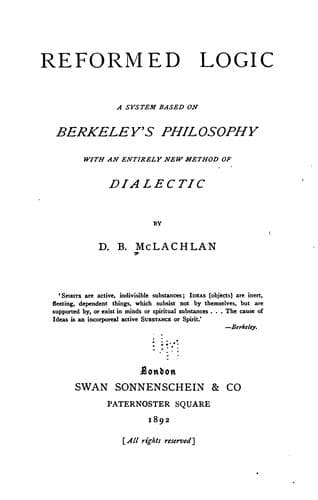
Reformed Logic: A System Based on Berkeley's Philosophy with an Entirely New Method of DialecticMcLachlan, D. B.
Philosophy
Reformed Logic: A System Based on Berkeley's Philosophy with an Entirely New Method of Dialectic
McLachlan, D. B.
Logic
Materialism presents at first sight the data out of which to construct
a theory of memory, for it recognises the dependent character of
consciousness and takes body to be its substance. Does the body show
any marks or traces of thought that may serve to revive ideas in the
absence of objects? None have yet been discovered. Nerves are used in
objective observation, but they do not appear to be essential either
to recollection in general or to any of the more elaborate forms of
internal thought. The brain is used only when giving expression to
thought.
Memory is noticed by everyone, even the least metaphysical. Persons
who are incapable of understanding the difference between object and
subject or general and particular, are yet perfectly well aware of the
difference between remembering and forgetting. The phrases relating
to this distinction are the commonest in every language. Memory is
conspicuous--notorious--palpable. It is the pivot on which the whole
mental system revolves. It cannot be gainsaid or ignored. There is no
profit in boycotting it in the manner recommended by Mill--it must be
faced and explained. 'How do you account for memory?' should be the
first question addressed to one who pretends to have a science of
mind. If he has no plausible answer to give, his system is not
worth discussion. A philosophy without a theory of memory is like an
astronomy without gravitation.
X--MEMORY OF SENTIMENTS
Sentiments are remembered and recollected like objects. For instance,
a boy is punished for doing wrong and has _pain_; he does wrong again
and is haunted with the _fear_ of being punished again, which is
the recollected and anticipated pain. We have thus two species of
sentiment corresponding exactly to object and idea. The word 'feeling'
is appropriate to the first, 'emotion' to the second. 'Passion' is a
strong degree of either.
Objects that are associated with feelings are better remembered than
those that merely affect the intellect, for there is a double memory
at work--one in the core and one on the surface of our mind.
Sentiments are not susceptible of the same degree of analysis as
objects. The inner matrix is more fluid and does not keep details.
Apart from the objects associated with feelings, there is not much
opportunity or need for classifying them. We are happy, wretched, or
indifferent--that sums up the sentimental experience.
Public-domain text, read in full here on John Shaqi.
Reviews
Reviews
No reviews yet
Be the first to share your thoughts on this work.
Join the Discussion
Join the discussion
Sign in to leave a comment or review.
Sign InorCreate an account