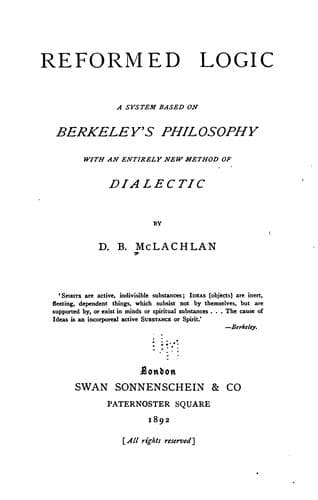
Reformed Logic: A System Based on Berkeley's Philosophy with an Entirely New Method of DialecticMcLachlan, D. B.
Philosophy
Reformed Logic: A System Based on Berkeley's Philosophy with an Entirely New Method of Dialectic
McLachlan, D. B.
Logic
of the _abstract_ [general] _idea_. Upon the same account the
spontaneous motion must be neither walking, nor flying, nor
creeping; it is nevertheless a motion, but what that motion is
it is not easy to conceive.'
This is a fair paraphrase of the accounts given by metaphysicians of
the manner of forming general ideas. It is also in itself a perfectly
correct account of the process, considered simply as a manifestation
of consciousness or a succession of states of consciousness, that is,
apart from the substantial plasmic operation of which it is merely the
symptom. Berkeley however denies that it is a true statement of what
takes place in the mind of consciousness.
'Whether others have this wonderful faculty of abstracting
their ideas, they best can tell; for myself, I find indeed
I have a faculty of imagining or representing to myself, the
ideas of those particular things I have perceived, and of
variously compounding and dividing them. I can imagine a man
with two heads, or the upper parts of a man joined to the body
of a horse. I can consider the hand, the eye, the nose each by
itself abstracted or separated from the rest of the body.
But then, whatever hand or eye I imagine, it must have some
particular shape or colour. Likewise the idea of man that I
frame to myself must be either of a white, or a black, or
a tawny, a straight, or a crooked, a tall, or a low, or a
middle-sized man. I cannot by any effort of thought conceive
the abstract idea above described. And it is equally
impossible for me to form the abstract idea of motion distinct
from the body moving, and which is neither swift nor slow,
curvilinear nor rectilinear; and the like may be said of all
other abstract general ideas whatsoever. To be plain, I own
myself able to abstract in one sense, as when I consider
some particular parts or qualities separated from others,
and which, though they are united in some object, yet it is
possible they may really exist without them. But I deny that
I can abstract from one another, or conceive separately, those
qualities which it is impossible should exist so separated;
or that I can form a general notion, by abstracting from
particulars in the manner aforesaid--which last are the two
proper acceptations of _abstraction_. And there is ground to
think most men will acknowledge themselves to be in my case.
The generality of men which are simple and illiterate never
pretend to _abstract notions_ [general ideas]. It is said they
are difficult and not to be attained without pains and study;
we may therefore reasonably conclude that, if such there be,
they are confined only to the learned.'
Public-domain text, read in full here on John Shaqi.
Reviews
Reviews
No reviews yet
Be the first to share your thoughts on this work.
Join the Discussion
Join the discussion
Sign in to leave a comment or review.
Sign InorCreate an account