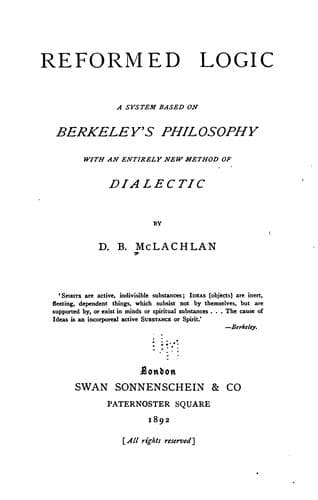
Reformed Logic: A System Based on Berkeley's Philosophy with an Entirely New Method of Dialectic — John Shaqi
Reformed Logic: A System Based on Berkeley's Philosophy with an Entirely New Method of DialecticMcLachlan, D. B.
Philosophy
Reformed Logic: A System Based on Berkeley's Philosophy with an Entirely New Method of Dialectic
McLachlan, D. B.
Logic
It is quite true that 'the simple and illiterate never _pretend_ to
abstract notions,' for the sufficient reason that they do not know
the names of their mental operations, even if they are capable of
discriminating them. For the same reason they do not pretend to talk
prose or to be realists.
The practice of every profession and craft, even the humblest,
involves abstraction and generalisation. The objective properties
associated with a given utility have to be abstracted from those which
are indifferent, and this is what enables men of experience in
any branch of industry or art to form a speedy judgment on matters
touching their special affairs. It is in part what distinguishes the
'professional' from the 'amateur.'
Berkeley's disclaimer of any power in himself to form general ideas
is no doubt sincere, and he is justified in reasoning from himself to
others. But the point at issue is, whether Berkeley in this instance
correctly analysed his own mental processes. The fact that he was
correct in some points of great importance does not preclude us from
surmising that he may have been wrong in others of less importance.
In comparison with his discovery of the substantiality of mind, his
oversight on the subject of abstraction is a bagatelle.
He explains the existence of general words on the theory that they are
names of particular ideas which we use to represent all similar ideas.
'... an idea which, considered in itself, is particular,
becomes general by being made to represent or stand for all
other particular ideas of the same sort. To make this plain by
an example, suppose a geometrician is demonstrating the method
of cutting a line in two equal parts. He draws, for instance,
a black line of one inch in length: this, which in itself is
a particular line, is nevertheless with regard to its
signification general, since, as it is there used, it
represents all particular lines whatsoever; so that what is
demonstrated of it is demonstrated of all lines, or, in other
words, of a line in general. And, as _that particular line_
becomes general by being made a sign, so the _name_ "line,"
which taken absolutely is particular, by being a sign is made
general. And as the former owes its generality not to its
being the sign of an abstract or general line, but of all
particular right lines that may possibly exist, so the latter
must be thought to derive its generality from the same cause,
namely, the various particular lines which it indifferently
denotes.'
These extracts will suffice to show what was Berkeley's doctrine on
the subject of general ideas.
Public-domain text, read in full here on John Shaqi.
Reviews
Reviews
No reviews yet
Be the first to share your thoughts on this work.
Join the Discussion
Join the discussion
Sign in to leave a comment or review.
Sign InorCreate an account