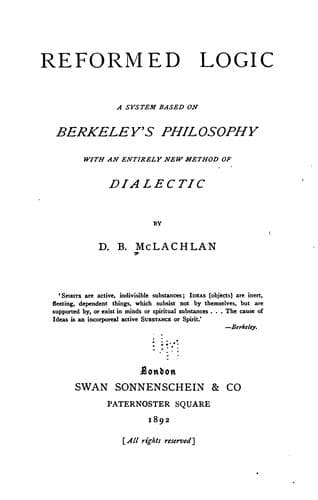
Reformed Logic: A System Based on Berkeley's Philosophy with an Entirely New Method of Dialectic — John Shaqi
Reformed Logic: A System Based on Berkeley's Philosophy with an Entirely New Method of DialecticMcLachlan, D. B.
Philosophy
Reformed Logic: A System Based on Berkeley's Philosophy with an Entirely New Method of Dialectic
McLachlan, D. B.
Logic
With respect to the analogy supposed to exist between the generality
of a name and the generality of a general idea, it has to be observed
that a name owes its generality solely to its being the sign of a
general idea. It is an imputed or conventional generality,--in its
proper character a general name is concrete and individual. Also it
does not resemble the thing it signifies (the general idea), nor the
concrete things from which that has been derived.
The generality of a general idea, on the other hand, depends
altogether on its _resemblance_ to many particular things. It is
independent of convention. Hence there is no real analogy between the
two generalities.
Considering that Berkeley professes himself unable to imagine abstract
properties, it is surprising how easily and naturally he writes about
geometrical lines--which are abstract properties. Probably he means
concrete _strokes_.
What sort of representation can subsist between one concrete stroke
and every other concrete stroke? If it is straight it will not
correctly represent a curve; if it is curved it will not represent
a straight stroke. A stroke an inch long cannot stand for a stroke a
hundred miles long; a black stroke does not properly represent a red
stroke. So it is incorrect to say that 'what is demonstrated of _it_
is demonstrated of all strokes, or, in other words, of a stroke
in general.' A particular object can stand only for itself, and
if general words stand for many things it is not by direct
representation, but because they first suggest general ideas, which
are the true substitutes of many particular things.
A reference to geometrical objects, themselves so abstract, is a
doubtful mode of showing how well one concrete thing can represent
others. Had Berkeley taken a more complex object as his general
representative he would have seen the weakness of his argument.
Suppose a biologist has to discourse on a province of animal life
comprising many species, and takes an individual of one species as a
representative of the whole. His sample is perhaps a hare, but he
has to treat of birds and fishes. What is to prevent his hearers from
concluding that birds are furred animals and fishes quadrupeds? Are
they to be expected to see in the hare only the properties common to
all the animals reviewed? If so they have the power denied them
by nominalists of forming a pure general idea, and the hare is
superfluous. The common properties could have been defined and
imagined without a concrete specimen, with irrelevant attributes,
being brought into the discourse.
All nominalists insist that if we think long on a general idea it
becomes particular, and from this they argue that it is not, and never
has been, a general idea[11].
Public-domain text, read in full here on John Shaqi.
Reviews
Reviews
No reviews yet
Be the first to share your thoughts on this work.
Join the Discussion
Join the discussion
Sign in to leave a comment or review.
Sign InorCreate an account