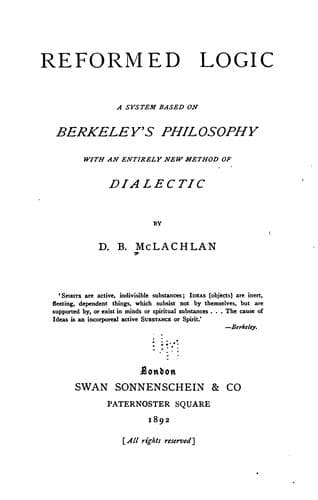
Reformed Logic: A System Based on Berkeley's Philosophy with an Entirely New Method of DialecticMcLachlan, D. B.
Philosophy
Reformed Logic: A System Based on Berkeley's Philosophy with an Entirely New Method of Dialectic
McLachlan, D. B.
Logic
The experiments of this sort proposed by logicians are misleading,
because we are without the ordinary motives for thinking generally.
In practical thought we have some sufficient reason for attending to
a fraction of consciousness and excluding the rest, and the irrelevant
qualities are distinctly less charged with attention than the
principal quality.
The power of abstracting thought is a matter of education. It is that
ruling of the spirit which is more difficult than the capture of a
city. We have to master the restless energic Self and fix it down on a
particular plasmic figure, or a mere point or edge of one, preventing
the energy from spreading to adjacent images. That is irksome and
fatiguing, but it is only a high degree of the faculty everyone
possesses of distinguishing particular objects from each other. Some
minds are so flaccid that you cannot hold them to one subject, even
the most particular and obvious, for five minutes at a time. Training
enables us to bring into the focus of attention just what we wish to
observe or think about, and leave the rest in the background, however
closely it may be connected with the matter that immediately interests
us. But for this power much of our energy would be expended to no
purpose. Abstraction is simply attention of a minute and concentrated
kind--a bringing of our energy of observation or recollection to a
fine point.
When abstraction need not be prolonged--when we are free to pass
rapidly from one general or abstract idea to another--there is no
difficulty in partial thinking. We skim over the plasmic imprints,
lightly brushing the surface of each where it is most prominent and
therefore most general, but not pausing to recollect particulars. It
is this rapid delicate touch we oftenest use in actual thought; but
when for purposes of experiment we come down heavily on an imprint,
then the Self overflows to adjacent channels and particular memories
are stirred up, in spite of every effort to limit our attention.
So common and easy is rapid general thought that it is constantly
used as a substitute for concrete thought, when a sketchy treatment of
things is all that is wanted.
'A bird has alighted on the fence.' The speaker saw a particular
concrete bird, and might have tried to describe it in the concrete.
But the attributes that rendered it concrete are supposed not to be
of present importance, and the hearer is consequently invited to think
only of bird in general. Would a nominalist affirm that in such a case
the words are meaningless unless the idea is concreted--unless the
general sketch is filled out in detail?
Take another example. 'The man sat by the window overlooking the river
that flowed towards the city.'
Public-domain text, read in full here on John Shaqi.
Reviews
Reviews
No reviews yet
Be the first to share your thoughts on this work.
Join the Discussion
Join the discussion
Sign in to leave a comment or review.
Sign InorCreate an account