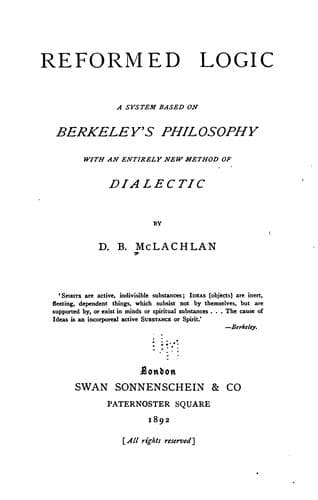
Reformed Logic: A System Based on Berkeley's Philosophy with an Entirely New Method of DialecticMcLachlan, D. B.
Philosophy
Reformed Logic: A System Based on Berkeley's Philosophy with an Entirely New Method of Dialectic
McLachlan, D. B.
Logic
Here all the nouns are general, but the picture is individual and
concrete. It is also quite intelligible, as a sketch. We can think of
a man without assigning to him any particular type of face, or colour
of hair, or stature, or age, or clothing. Our idea is the general idea
_man_ used as a sketch of a particular man. He is in a house because
he is looking through a window, but we do not stay to imagine the
house as cottage, inn, or mansion. We call up the general idea
_house_, which is definite enough for our purpose, and we cannot doubt
for a moment that we have such a general idea. The river may be wide
or narrow, straight or crooked, navigable or not, but we think only
of the general idea _river_, which is water flowing between banks. And
surely we can imagine a general _city_ without giving it any definite
size, or form, or nationality, or number of inhabitants!
These considerations clearly demonstrate that we have general ideas,
which are not merely concrete ideas used as examples, and if we can
employ them in the manner just indicated, where a light superficial
recollection is all that is necessary, we can equally well use them
in their more legitimate character, as signs of certain general
utilities.
XV--ERRORS WITH RESPECT TO GENERALISATION
Generalisation has been the bane of European philosophy. It has
monopolised well-nigh the whole metaphysical attention. It has been
considered the radical fact of mind from which all others have grown,
whereas it is no more than a method for abbreviating recollection.
It neither reveals to us new things, nor reduces the multiplicity of
things actually existing.
Plato insisted on the importance of general thought as against the
fluctional idealism of Heraclitus, but he was wholly mistaken as
to the nature of general ideas. He thought they were external
objects--also types and causes of primary objects. But patterns are
not causes, and general ideas are quite obviously suggested by things,
not things derived from general ideas. The notion that the general
idea is either the cause, or an image and revelation of the cause, of
things is an error of perennial recurrence. In some form or other it
is always with us.
Plato also taught that general ideas are recollections of knowledge
acquired in the condition prior to embodiment, which the objective
experience of this life serves to revive. These several doctrines are
somewhat inconsistent with each other. The last is interesting but
lacks confirmation.
Aristotle admitted the superiority of general over particular ideas,
and thought that the former corresponded to some specially important
part of objects called the 'essence.'
Public-domain text, read in full here on John Shaqi.
Reviews
Reviews
No reviews yet
Be the first to share your thoughts on this work.
Join the Discussion
Join the discussion
Sign in to leave a comment or review.
Sign InorCreate an account