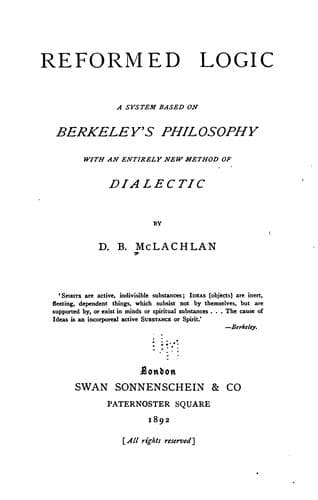
Reformed Logic: A System Based on Berkeley's Philosophy with an Entirely New Method of DialecticMcLachlan, D. B.
Philosophy
Reformed Logic: A System Based on Berkeley's Philosophy with an Entirely New Method of Dialectic
McLachlan, D. B.
Logic
This is nearer the truth. The essence of an object is that part of
it, which being present, a given sentimental result follows, or may be
expected to follow, or may be made to follow. A certain experience of
things is necessary before we can know what is the objective minimum
consistent with some sentimental utility. If things are classified
with due regard to their utilities, the essence will be the same as
the general idea. It is however not true that the essence or any other
part of the object causes the sentimental effect (VII).
A common form of the generalistic superstition is to suppose that a
thing is explained or sufficiently accounted for by classifying it.
In all philosophies of Greek derivation--the Asiatic seem to be free
from this defect--reason is considered to be 'the bringing of a thing
under a class-notion,' and when this is done we are supposed to know
the thing completely. An elaborate and utterly false dialectic has
been erected on this foundation.
No doubt our first attempt at explaining a thing is to refer it to a
general idea--to classify it. This usually suggests something to add
to the bare phenomenon by way of explanation or hypothesis. But only
if we have a prior knowledge of the general idea, derived from things
better known than the present phenomenon. The general idea is simply
a short formula of that prior knowledge. Suppose we thoroughly know
a body of similar things _a_, _b_, _c_, and also reduce them to the
general image X; then on seeing _d_ and noticing that it is like
_a_, _b_, _c_, we briefly think, 'Oh, it is X,' which excuses us from
studying it further. We at once transfer to _d_ our whole knowledge
of _a_, _b_, _c_, and in this ideal transfer the explanation
consists--not in the classification. The transfer is often tacit--if
explicit it is an 'argument.'
If there has been no better known _a_, _b_, _c_, it is evident that
the mere generalisation of new facts _d_, _e_, _f_, will not add
anything to our knowledge of _them_. In deduction we should only
return to them the knowledge just extracted from them. We should be
explaining things by themselves--reasoning in a circle[12].
The _unity_, which explains is not the general idea. It is a unity of
function or service, and may include things utterly heterogeneous, and
therefore incapable of being reduced to a common idea. The pen in my
hand consists of wood and metal; if I generalise them into Matter--the
nearest class that includes both--I do not thereby explain the pen.
But it is explained by the unity of service: the wood and metal
contribute to form one instrument for writing.
Public-domain text, read in full here on John Shaqi.
Reviews
Reviews
No reviews yet
Be the first to share your thoughts on this work.
Join the Discussion
Join the discussion
Sign in to leave a comment or review.
Sign InorCreate an account