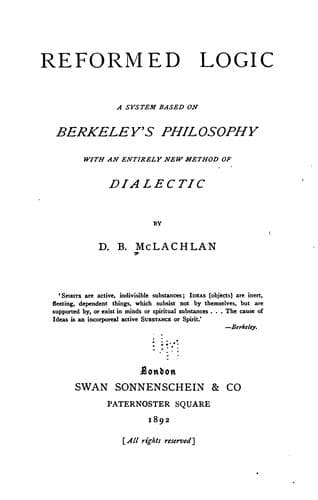
Reformed Logic: A System Based on Berkeley's Philosophy with an Entirely New Method of DialecticMcLachlan, D. B.
Philosophy
Reformed Logic: A System Based on Berkeley's Philosophy with an Entirely New Method of Dialectic
McLachlan, D. B.
Logic
The best results of modern science are discoveries of utilities
(inventions); discoveries of the relations of sequence among objects,
which enable us to predict their arrival years in advance; of
coexistences on the great cosmic scale (geographical and stellar
exploration); of co-inherence of properties in individual objects
(chemistry). Yet science is still too generalistic. It runs too much
to classification and nomenclature, which is nothing but _memoria
technica_. Modern biology presents a curious return of Platonism. The
general idea is not indeed put forward as the cause of individuals,
but a particular concrete animal is found who closely resembles the
general idea, and it is imagined that an animal like him was the
original cause of all animals of his species. When it happens--as
it occasionally must in a thorough-going system of phenomenal
classification--that the average or general idea falls between two
species, no individual can be found to represent it with the desired
exactness. In this case it is supposed by evolutionists that the
intermediate animal has existed but is now extinct. These are the
'missing links' so badly wanted to complete the evolutionary scheme.
[Footnote 10: 'Mysticism is neither more nor less than
ascribing objective existence to the subjective creations
of our own faculties, to ideas or feelings of the
mind.'--_Logic_, chapter on 'Fallacies.']
[Footnote 11: With equal plausibility it might be argued that
we have no particular ideas, because it is difficult if not
impossible to observe and remember all the details of any
object. Our most particular ideas are slightly abstract,
and in the process of forgetting they become more and more
abstract, until they disappear altogether.]
[Footnote 12: Mill's nominalistic tendencies led him to the
same conclusion: 'Our general ideas contain nothing but what
has been put into them, either by our passive experience, or
by our active habits of thought; and the metaphysicians in all
ages, who have attempted to construct the laws of the universe
by reasoning from our supposed necessities of thought, have
always proceeded, and only could proceed, by laboriously
finding in their own minds what they themselves had formerly
put there, and evolving from their ideas of things what they
had first involved in those ideas.'--_Logic_, Bk. V. c. 3. §
3.]
IMAGINATION
XVI
This faculty or habit consists essentially in combining ideas
(particular or general), or objects and ideas, so as to form systems
different from those occurring in actual experience. The whole has
never been perceived, though all its elements have been perceived.
Public-domain text, read in full here on John Shaqi.
Reviews
Reviews
No reviews yet
Be the first to share your thoughts on this work.
Join the Discussion
Join the discussion
Sign in to leave a comment or review.
Sign InorCreate an account