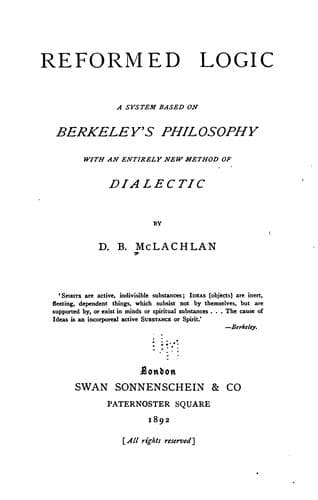
Reformed Logic: A System Based on Berkeley's Philosophy with an Entirely New Method of DialecticMcLachlan, D. B.
Philosophy
Reformed Logic: A System Based on Berkeley's Philosophy with an Entirely New Method of Dialectic
McLachlan, D. B.
Logic
Any association of ideas may be called imaginary if it occurs in an
order different from the order of experience. But the term Imagination
is properly confined to novel combinations deliberately and
consciously formed to serve some utility. It is thus distinguished
from Reverie, in which no choice or control enters into the
recollection.
We control our ideal associations by means of comparison, which is
therefore what distinguishes imagination from reverie. For instance,
if I see a vase from which the handle has been broken off, I can
imagine the handle restored, but to do this I must be able to compare
the broken vase with a similar whole vase, or with the general idea
'whole vase.' The combination I form is novel, for I have never
seen this particular vase in a whole state; if I had I should not be
imagining it but recollecting it.
There are two principal distinctions to be noticed in imagination; one
relates to the mode of forming the imaginary idea, the other to its
use.
In the above case we form the whole by mechanical extension or
addition. The process is as simple as nailing one piece of wood to
another. But suppose the broken vase is of porcelain and the whole one
of bronze, the restoration can still be made, but it is no mechanical
junction of two previous ideas. It is a fusion of the material
supplied by one idea with a form supplied by another. On the same
principle a vase may be wholly designed from hints supplied by a score
or more of vases, differing in material, in size, colour, decoration,
and so forth. In these cases the new idea may be said to be totally
different throughout its length from any other and from any object.
Yet it is a combination of previous ideas. We do not create any
absolutely new idea. This may be called imagination by _transfusion_.
The elements may be so well mixed that it is impossible to trace each
back to its origin.
Transfusion may be further complicated by recompounding ideas already
compound. This occurs, as we shall see, in forming the 'external
world' of materialists and realists.
The two uses to which imaginary ideas are put are the Artistic and the
Rational.
We have seen (X) that emotions may be excited by objects or ideas.
Hence, agreeable emotions may be excited by suggesting the objects
associated with the original agreeable feelings; and novel emotions
may be excited by novel combinations of the ideas of experienced
objects that have been signs of feelings. From this possibility has
arisen that extensive province of activity called ART, which consists
in imagining novel combinations of things capable of exciting novel
and pleasurable emotions (not feelings), and in finding means of
suggesting such ideas to others. Some of these combinations are so
subtle, and the emotions they excite so exquisite, that we value the
artistic work at a great price, and rank the man who imagined it among
the benefactors of his species.
Public-domain text, read in full here on John Shaqi.
Reviews
Reviews
No reviews yet
Be the first to share your thoughts on this work.
Join the Discussion
Join the discussion
Sign in to leave a comment or review.
Sign InorCreate an account