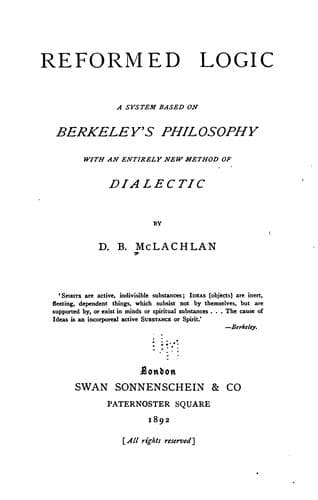
Reformed Logic: A System Based on Berkeley's Philosophy with an Entirely New Method of Dialectic — John Shaqi
Reformed Logic: A System Based on Berkeley's Philosophy with an Entirely New Method of DialecticMcLachlan, D. B.
Philosophy
Reformed Logic: A System Based on Berkeley's Philosophy with an Entirely New Method of Dialectic
McLachlan, D. B.
Logic
REASON, or the Rational Imagination, does not appeal directly to the
emotions. It serves the uses of life by enabling us to imagine what we
have not yet experienced but may have to experience, and the quality
aimed at is accuracy of intellectual ideation, not emotional pleasure.
It is found by experience that an intellect well furnished with ideas
may learn to combine them into pictures or preconceptions of the
future, and the indirect utility of this accomplishment is very great.
If it does not, like art, give immediate sentimental pleasure,
it often enables us so to control events that we are brought into
conditions affording more lasting satisfaction than many expensive
works of art. Reason, then, is the imaginative faculty applied to the
purpose of acquiring ideas of experience that has not yet taken place,
and it is good in proportion to the similarity of the idea to the
anticipated or unknown experience.
Although imagination is more important than generalisation, it has
received little attention from metaphysicians. Their treatment of it
is not uniform, but it generally exhibits two fundamental defects.
They consider it an independent or ultimate faculty, that is, one
incapable of resolution into anything more simple. We have seen that
it is an application of comparison, and comparison depends on the
coincidence of particular ideas.
Then they regard imagination only in its artistic uses, not
perceiving that it is also the basis of reason. Reason they treat
as generalisation--a vice that pervades all their systems. They put
reason and art in essential opposition, whereas the difference between
them is only specific--a difference of use.
Some metaphysicians confound imagination with mere recollection. 'It
is,' says one of them, 'the faculty representative of the phenomena
both of the external and internal worlds.' But there is a great
difference between the representation of what we have experienced
actually, and the representation of a future and perhaps impossible
event: the latter only is imaginative. 'There is no train of ideas,'
says another, 'to which the term imagination may not be applied.' If a
man at the end of the day calls to mind all the events of the day in
a train of ideas, that is recollection, and would be very
inappropriately termed imagination. According to a third, imagination
has for its object the concrete as opposed to abstractions and
generalities. This also is inexact. A traveller may describe in
general the qualities of a foreign country or tribe of men, and we
shall imagine that generality without a concrete picture. The power of
imagining generalities and abstractions necessarily follows from the
power of forming them in the first instance.
DIALECTIC
XVII--ITS SCOPE
Public-domain text, read in full here on John Shaqi.
Reviews
Reviews
No reviews yet
Be the first to share your thoughts on this work.
Join the Discussion
Join the discussion
Sign in to leave a comment or review.
Sign InorCreate an account