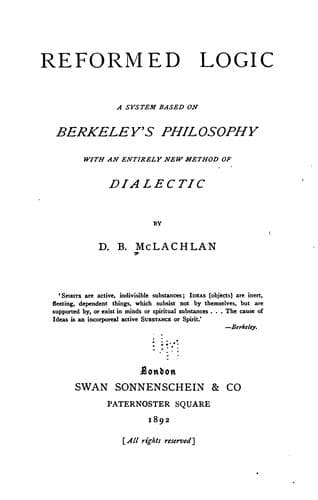
Reformed Logic: A System Based on Berkeley's Philosophy with an Entirely New Method of DialecticMcLachlan, D. B.
Philosophy
Reformed Logic: A System Based on Berkeley's Philosophy with an Entirely New Method of Dialectic
McLachlan, D. B.
Logic
The derivation of Reason as given in the preceding sections may be
summed up thus:--the meeting of Minds gives Perception or primary
experience; Attention selects therefrom objects of special interest
to the observer; Memory retains impressions of these in the mental
plasma, by which ideas of them are recollected though the originating
mind be not present; community with divergence of imprint gives rise
to Comparison; from this are derived Imagination and Generalisation;
from imagination emerge Reason and Art.
Generalisation is thus only a collateral relation of reason, not
its immediate parent nor in the direct line of descent. It is not
essential to reason, but may enter as a subsidiary process into an
argument. If the things we argue about are numerous it will be more
correct to generalise them and then argue from the general idea,
than to argue from one concrete object to another. But innumerable
inferences are drawn from one particular thing to another, and these
involve no generalisation.
Reason is chiefly the art of predicting by means of the intellect what
will occur to us in the future. Its use is to enable us to prepare
for future events in so far as our resources permit. We never predict
quite accurately, but general preconceptions are better than none
at all. The same process by which we preconceive the future can be
applied to the conception of what is actually taking place but not
within our ken--as at the antipodes--and can be applied also to events
that took place in the past and will never be experienced by us. It
might be objected that as regards the past we can have no motive in
imagining it, seeing we can never experience it. But a conception of
the past is often a necessary condition of our conceiving the future,
and is artistically interesting. It awakens pleasing emotions to be
able to picture to ourselves, even imperfectly, states of the world
and of society that have long been obsolete.
An investigation of the manner in which reason supplies us with ideas
of the unknown, involves the consideration and arrangement of so
many details that it may be regarded as a small science in
itself--DIALECTIC.
A dialectician (logician in the narrower sense) is neither a
grammarian nor an encyclopedia of the best information on every
subject. His office consists in deciding whether certain theorems
are arguments or not. An ARGUMENT is an act or product of rational
imagination. Theorems which purport to be arguments, but are not, are
FALLACIES.
Public-domain text, read in full here on John Shaqi.
Reviews
Reviews
No reviews yet
Be the first to share your thoughts on this work.
Join the Discussion
Join the discussion
Sign in to leave a comment or review.
Sign InorCreate an account