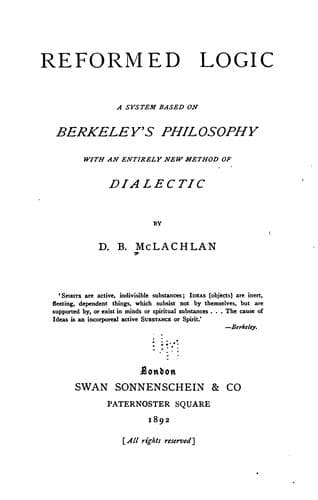
Reformed Logic: A System Based on Berkeley's Philosophy with an Entirely New Method of DialecticMcLachlan, D. B.
Philosophy
Reformed Logic: A System Based on Berkeley's Philosophy with an Entirely New Method of Dialectic
McLachlan, D. B.
Logic
A fallacy is not merely a _bad_ argument--it is no argument at all.
Quite apart from fallacy there is a goodness and badness in arguments,
but with this discrimination the dialectician (as such) has nothing
to do. Only persons experienced in the matter are competent to decide
between good and bad arguments. Hence when the quality of an argument
is in question the dialectician takes no part in the debate: he is
neither combatant nor umpire. He is at most an impartial president
whose chief duty is to see that people do not debate about mere words
and foregone conclusions. Granting that a theorem has the qualities
of an argument, the dialectician is not competent to say that it is
improper or too trivial to be discussed. He is not a judge of what
people ought to be interested in.
From his better knowledge of what constitutes rational prediction, a
dialectician may offer his services to disentangle and render explicit
involved and partial arguments. Many people reason well who are yet
unable to express themselves coherently. A dialectician should be able
to reconstruct an argument from the slightest hint, as a naturalist
imagines an animal from a single bone. In ordinary reasoning the
arguments are seldom fully expressed, and the reasoners themselves are
not always quite conscious of the premises from which they argue. All
such suppressed and overlooked assumptions should be brought to light
by dialectic, the aim of which is to render reason as self-conscious
as possible.
Though a dialectician need not be an expert in any department of
knowledge, he must know the facts on which an argument is built,
otherwise he may be deceived by equivocal language. Reverting to the
instance of the vase--the dialectician must have seen both the whole
vase and the broken vase, but he need not have any opinion as to
whether the proposed handle is the most suitable, or not. That must
be left to those who are familiar with vases and who are interested in
the restoration of the one in question.
The definition here given of the scope and office of dialectic may
appear to some too modest. But in reality there is a great deal
involved in it. Philosophers have been discussing Reason for twenty
centuries or more, and have not produced a satisfactory definition
of it. Consequently they cannot decide with any confidence whether a
theorem is an argument or a fallacy. The cleverest of them give
their sanction to theorems that are demonstrably fallacies. They are
evidently judging more by ear than by rule. All this causes confusion
of mind and waste of energy.
Public-domain text, read in full here on John Shaqi.
Reviews
Reviews
No reviews yet
Be the first to share your thoughts on this work.
Join the Discussion
Join the discussion
Sign in to leave a comment or review.
Sign InorCreate an account