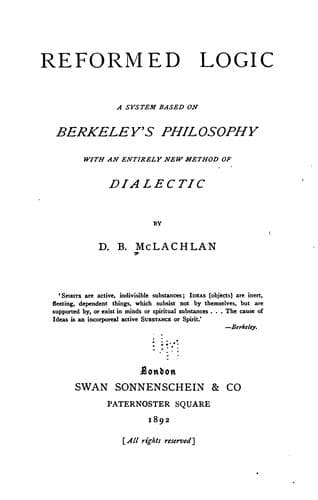
Reformed Logic: A System Based on Berkeley's Philosophy with an Entirely New Method of Dialectic — John Shaqi
Reformed Logic: A System Based on Berkeley's Philosophy with an Entirely New Method of DialecticMcLachlan, D. B.
Philosophy
Reformed Logic: A System Based on Berkeley's Philosophy with an Entirely New Method of Dialectic
McLachlan, D. B.
Logic
Dialectic takes its general idea of reason from the higher analysis
of logic, and brings the general idea to bear on concrete arguments.
A dialectician makes a collection of theorems for study just as
a botanist makes a collection of plants. He sorts them out into
convenient classes, separates the valid or useful from the erroneous
and misleading, studies the relation of language to argument and the
influence for good or ill that words have upon rational thought.
From the example of the vase cited above it will be seen that in
every act of reason two principal things are requisite. There must
be something wholly known (or comparatively well known) and something
less well known, and the reasoning or argument consists in ideally
completing the latter on the model of the former. If we would predict
the coming of a future season of the year we must have a picture in
the mind of all the seasons in the order in which they occur. If we
would go straight to a place on the surface of the earth we must have
a plan of the way in our imagination. If we would predict the effect
of a drug on an animal body we must have previously noticed the effect
it has produced--and so on. Neither the mind nor intellect supplies
spontaneously any of these models; they are all formed out of actual
experience remembered and recollected. When they have been refined
into extremely general ideas they are apt to be taken for innate
tendencies of the intellect, as Kant erroneously thought. They are not
so; all we know of the intellect is consistent with the belief that
it begins with pure plasm without a trace of idea, and is absolutely
indifferent to the imprints it may receive. Doctrines of innate
ideas--innate forms of thought or categories--innate 'principles' of
various kinds--are devices of metaphysicians to cover the weakness of
their theories.
The two main parts of an argument divide naturally into four
subdivisions. There is the thing argued about (corresponding to the
broken vase); there is the ideal extension or restoration; in the
model we reason from there are the parts corresponding to each of
these. I propose to take terms for these four parts from one of the
most important, formal and correct modes of reasoning--the application
of a precedent or statute to a case in Law.
XVIII--THE RATIONAL PARALLEL
Every argument, whatever be the matter of it, consists in bringing
a _Case_ under a _Precedent_, and applying to the case ideally the
better knowledge possessed of the precedent. The _Conclusion_ (also
called Inference or Deduction) is the result of this application, and
is always an addition to our stock of ideas.
A conclusion has never the same reality as actual experience. It is
not 'true' in that sense, though it may be 'morally' true, that is,
we are ready to act upon it without hesitation--to stake our life or
fortune on it. As regards actual or experienced fact there can be no
argument, since it is useless to 'predict' what we already know.
Public-domain text, read in full here on John Shaqi.
Reviews
Reviews
No reviews yet
Be the first to share your thoughts on this work.
Join the Discussion
Join the discussion
Sign in to leave a comment or review.
Sign InorCreate an account