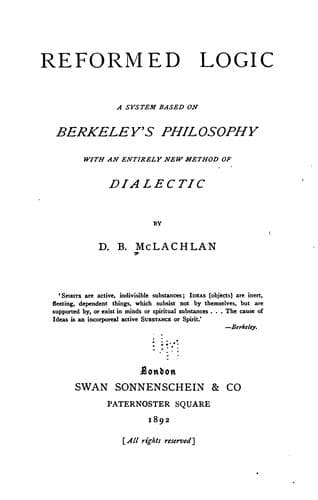
Reformed Logic: A System Based on Berkeley's Philosophy with an Entirely New Method of DialecticMcLachlan, D. B.
Philosophy
Reformed Logic: A System Based on Berkeley's Philosophy with an Entirely New Method of Dialectic
McLachlan, D. B.
Logic
Academical logicians have a doctrine the reverse of this. They assert
that their syllogisms yield conclusions that are always as certain as
the premises. Grant their premises and you are obliged to accept their
conclusions. This is so, because a regular syllogistic conclusion is
simply a restating in other words of the information, or part of the
information, already contained in the premises. If the syllogism has
any use at all, it is merely as an aid to recollection; no new idea
is generated by it. It is needless to insist on a fact so notorious as
that ordinary rational conclusions--those that form the staple of our
daily thought--are not by any means so certain as the data from which
they are drawn. For example, the sky is red and lowering this evening,
and we conclude therefrom that the weather will be bad to-morrow.
There is no doubt about the present aspect of the sky, but much doubt
about the inference.
The form of an act of reasoning or argumentation may be rendered
plainer by a diagram.
S A
--- ---
C _I_
--- ---
S A represents the precedent. S is the Subject or body of the
precedent; A (the _Applicate_) is one property, or a part, or a
relation of S abstracted from the rest to illustrate a case. C is the
case; _I_ is the conclusion (or inference). _I_ results from imagining
C to be associated with a property or relation similar to A. The sum
of our _I_'s constitutes what we know of the world and man before
we were born, of what is taking place in other parts of the world or
universe, of what may take place in the future, and of the concealed
and inaccessible parts of present objects. This is true not only
of the results of our own reasoning but of what we have learned as
verified knowledge from others, for the interpretation of language is,
in the last analysis, a rational conclusion.
All the parts of an argument exist in the mind, but they are not
always expressed in language. When treated dialectically the implicit
members are expressed, and the terms arranged so as to show as clearly
as possible the nature of the argument. The following are the
points most necessary to be observed in constructing or analysing an
argument.
(1) C must resemble S, for that is the basis of the argument. If C
is not felt to be like S, or (as sometimes happens) is explicitly
declared to be unlike S, there can be no conclusion. The precedent is
not applicable to the case. A may, or may not, be associated with S;
that is to say, a verbal negation may appear in the statement of the
relation of S to A, but there must be no negation with respect to the
relation of C to S.
Public-domain text, read in full here on John Shaqi.
Reviews
Reviews
No reviews yet
Be the first to share your thoughts on this work.
Join the Discussion
Join the discussion
Sign in to leave a comment or review.
Sign InorCreate an account