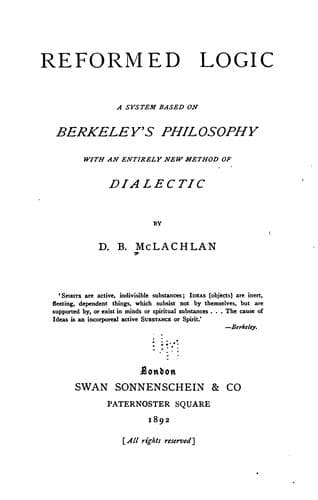
Reformed Logic: A System Based on Berkeley's Philosophy with an Entirely New Method of DialecticMcLachlan, D. B.
Philosophy
Reformed Logic: A System Based on Berkeley's Philosophy with an Entirely New Method of Dialectic
McLachlan, D. B.
Logic
The resemblance of C to S may, however, vary in degree from the
faintest analogy to community of species. The difference between them
may far outweigh their resemblance. There may even be no material
likeness, but only a similarity of function, or position, or of any
the most trivial attribute. Only it is to be observed that the kind
and degree of resemblance between S and C determine the kind
and degree of resemblance between A and _I_. We must not infer
specifically unless the case is specifically like the precedent.
In all other instances we can only infer proportionally or by
transfusion.
(2) None of the antecedents must be a verbal or identical proposition,
that is, a proposition which merely substitutes one name or nominal
phrase for another; nor must the case be merely the precedent
expressed in other words, or the precedent a paraphrase of the case.
In any of these circumstances one of the elements of the argument is
wanting; we have two names for one thing or two propositions giving
the same information.
(3) The precedent may (as has been already remarked) be a general
idea, or may be an individual idea or object. If S A has occurred
frequently it is certain to be generalised, and so may form a maxim,
a law, a rule, an induction, &c. But one well-observed precedent is
enough to suggest a conclusion, if there has been no experience to the
contrary. There is therefore no dialectical difference between arguing
from a general idea (class notion) to an individual or subordinate
idea, and arguing from one individual to another. Comparison and
inference occur in both.
(4) After separating A from S care should be taken that it is A and
not S that is used to generate _I_. Examples are plentiful of theorems
in which S and A change parts, which invalidates the conclusion. Other
errors in stating theorems intended to be arguments will be noticed
under the head of 'Fallacies.'
The following is an argument conformable to the above rules.
Tyrants | deserve death
--------------------+-----------------------------
Caesar was a tyrant | _no doubt he deserved death_
This square mode of stating the argument is adapted from the general
type, and brings out the mutual relations of the compared parts better
than the three-lined arrangement. The word 'therefore,' which usually
introduces a logical conclusion, is ambiguous. It may mean that the
antecedents are the causes of the fact mentioned in the conclusion,
or merely that the antecedents are the reasons why we believe the
conclusion. The former is the scientific 'therefore,' the latter is
the purely dialectical. I shall generally omit the illative word, and
print conclusions in italics, besides entering them invariably in the
fourth compartment of the parallel when this arrangement is adopted.
Public-domain text, read in full here on John Shaqi.
Reviews
Reviews
No reviews yet
Be the first to share your thoughts on this work.
Join the Discussion
Join the discussion
Sign in to leave a comment or review.
Sign InorCreate an account