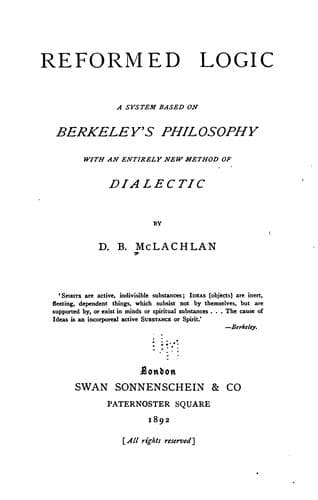
Reformed Logic: A System Based on Berkeley's Philosophy with an Entirely New Method of DialecticMcLachlan, D. B.
Philosophy
Reformed Logic: A System Based on Berkeley's Philosophy with an Entirely New Method of Dialectic
McLachlan, D. B.
Logic
An idea once generated in the intellect is not to be erased at
pleasure. It can be obliterated only by the process of forgetting. If
after we have formed a dialectical conclusion we meet with evidence
that contradicts it, the only result of that evidence is to affix
a mark of falsity to the conclusion, so that as often as it is
recollected the stigma is recollected too, and neutralises the effect
of the idea. A negative or destructive argument is thus, plasmically
speaking, a positive addition to the idea it seeks to efface. For the
time being it renders the idea more conspicuous, as the word CANCELLED
stamped in large letters across a document makes it more evident than
it was before; but no doubt the stigmatising of an idea hastens the
process of oblivion, for we thenceforth bestow less attention upon it.
Stigmatic arguments are not another species, but merely the ordinary
constructive arguments used for a particular purpose.
Suppose we have inferred from the general resemblance of the earth to
the moon that the latter is inhabited, we stigmatise this belief by
such an argument as--
Without air | animals cannot live
----------------------------+-----------------------------------
There is no air in the moon | _there can be no life in the moon_
There is an exception to the rule that argument is superfluous when
the speaker has already verified the conclusion. It is when he is
addressing a person who has not had the same experience as himself and
who doubts his word. The speaker may then resort to arguments drawn
from antecedents recognised by the hearer, if any such are applicable
to the subject. But a fact may be truly reported though neither the
witness nor a sceptical hearer can find dialectical antecedents to
prove it, for there may be no relation between the fact in question
and any prior knowledge they possess, or they may not be able to find
the relation.
This brings us again to that view of the intellect which represents
it as artificial and limited by experience. Man is rational only
on matters familiar to him; in utterly novel circumstances he is
irrational, and must fall back for guidance on his general mental
sentiment, or the advice of persons more experienced than himself.
XIX--HYPOTHETICAL ARGUMENTS
It is allowable to imagine ourselves placed in circumstances not yet
realised, or in possession of information not yet acquired, and
to anticipate or rehearse the reasoning we should employ under the
supposed conditions. Such arguments take in language a conditional or
hypothetical phraseology.
The case may be entirely fictitious, but I cannot find a valid
instance of a whole precedent being fictitious. Its dubiety turns on
our knowledge or ignorance of the applicate. Has a subject such or
such an attribute? Then it may be applied to illustrate a certain
case. 'If it is true that Damon and Pythias are inseparable, _then
Pythias must be in town_, for I have just seen Damon.'
Public-domain text, read in full here on John Shaqi.
Reviews
Reviews
No reviews yet
Be the first to share your thoughts on this work.
Join the Discussion
Join the discussion
Sign in to leave a comment or review.
Sign InorCreate an account