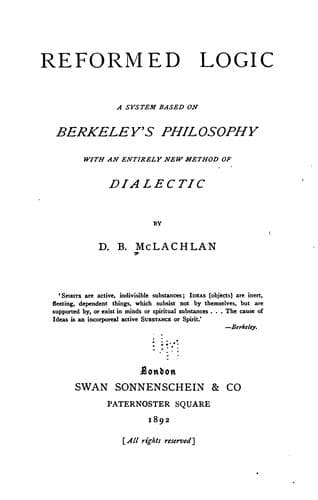
Reformed Logic: A System Based on Berkeley's Philosophy with an Entirely New Method of Dialectic — John Shaqi
Reformed Logic: A System Based on Berkeley's Philosophy with an Entirely New Method of DialecticMcLachlan, D. B.
Philosophy
Reformed Logic: A System Based on Berkeley's Philosophy with an Entirely New Method of Dialectic
McLachlan, D. B.
Logic
It is more often the case that is dubious. 'If Caius is a European _he
is white_, for all Europeans are white.' 'If Damon is in town _Pythias
is in town_, for they are inseparable.' 'If I were you _I should
defer the voyage to the summer season_, as I have always found winter
travelling disagreeable.' But the word 'if' does not always mark a
hypothetical thought. In the proposition, 'if children are neglected
they will grow up ignorant,' we have a dogmatic or assertorial
judgment--'neglected children grow up ignorant.' (Bain.)
The precedent may be suppressed in hypothetical as in dogmatic
argument. 'If the crops are good, corn will be cheap' implies the
unspoken precedent, 'good crops have been invariably followed by cheap
corn.' 'If logic is useless it deserves to be neglected,' carries the
mind to the more general thesis, 'all useless studies deserve to be
neglected.' 'If Great Britain should be invaded the volunteers will be
called out,' rests on the precedent judgment, 'it is the duty of the
volunteer army to repel invaders.'
Arguments in which both applicate and case are hypothetical are so
very dubious that they cannot be considered of any practical use.
'_If_ opium is poisonous, and _if_ this substance is opium, you will
be poisoned by taking this substance.'
The Aristotelian hypothetical is almost invariably a fallacy,
sometimes on more than one account. It usually consists of--first, a
conditional or doubtful statement; next, a solution of the doubt by
means of positive information; finally and by way of inference the
first statement is given without the doubt. Here is an example from
Jevons: 'If the barometer is falling, bad weather is coming; but the
barometer is falling; therefore bad weather is coming.'
Where did the information that the barometer is falling come from? If
we knew it before uttering the first proposition, we were affecting
an ignorance that did not exist. The second proposition takes away all
occasion for argument; it is an amendment of the first proposition,
and what we get from the theorem as a whole is a _case_, followed by
a prediction for which there is no precedent justification. We are
arguing in a circle.
'If Aristotle is right, slavery is a proper form of society; but
slavery is not a proper form of society; therefore Aristotle is not
right.' If we knew for certain (as the second proposition indicates)
that slavery is not a proper form of society, what is the use or
meaning of treating the question as hypothetical (as is done in
the first)? If we acquired the information after uttering the first
proposition, there was no occasion to go on with the argument; we
should have said simply, 'Slavery is not a proper form of society,
though Aristotle said it was.' It is needless, except for verbal
completeness, to say 'he was not right'--we have _logically_ said so.
Public-domain text, read in full here on John Shaqi.
Reviews
Reviews
No reviews yet
Be the first to share your thoughts on this work.
Join the Discussion
Join the discussion
Sign in to leave a comment or review.
Sign InorCreate an account