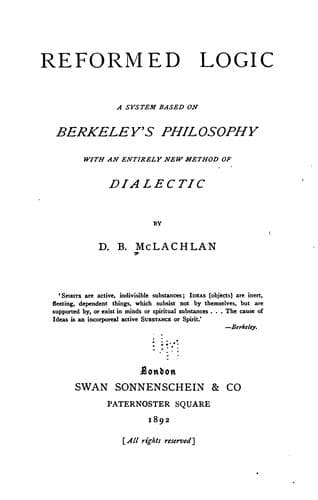
Reformed Logic: A System Based on Berkeley's Philosophy with an Entirely New Method of DialecticMcLachlan, D. B.
Philosophy
Reformed Logic: A System Based on Berkeley's Philosophy with an Entirely New Method of Dialectic
McLachlan, D. B.
Logic
When two or more alternative data are presented, of which only one
is valid or relevant to a proposed argument, but we know not at
first which the valid datum is, we have the _dilemma_ (_trilemma_,
_tetralemma_, &c.) of logicians. In such conditions we have a double
process to go through; we must first settle by observation or by an
auxiliary argument which of the alternative data to select, and then
work out the principal argument in the regular dogmatic form.
Suppose we have to determine dialectically the specific gravity of a
piece of metal, but do not know whether it is gold or gun-metal. It is
evident we must first somehow make up our mind as to its identity, and
then proceed on the usual method of argumentation. The 'making up
our mind' is probably itself an argument, and might be of this
character--'A piece of yellow metal stamped with what appears to be
a hall-mark, is more likely to be gold than gun-metal; this piece of
metal has traces of such a stamp; so I conclude _it is gold_.' Then
we proceed to the principal question--'The specific gravity of gold is
19·26; I have concluded that this object is gold; I conclude further
that _it has a specific gravity of_ 19·26.'
We may work out all the alternative conclusions first and fix on a
datum afterwards, as in deciding how we shall invest our money. 'If
I put my money in Consols I shall have a small return with good
security; if I buy Patagonian bonds I may have a large interest for a
time, but the security is bad.' The next thing to settle is whether
in our experience or on accepted principles small profit with good
security is, or is not, to be preferred to large profit and bad
security: having decided in favour of the former alternative, we now
choose our investment dogmatically--'A good security with small
profit is to be preferred; Consols are of this character; _they are a
suitable investment for me_.'
We may be unable to decide for any of the alternative data, but we
work out all the possible arguments as hypotheses, and so are prepared
in a degree for all the possible events. A person is seen approaching
our residence, but we cannot discern whether it is A. B., who is
a bore, or C. D., who is an entertaining companion. We argue
rapidly--'If it is A. B. _I shall have a bad half-hour_, for he always
wearies me; if it is C. D. _I shall have an agreeable distraction_,
for he is very amusing.'
According to the syllogists, the dilemmatic premises are a statement
of alternative data and the choice of one of them, and the inference
is the rejection of the remainder: or the rejection may be given as
matter of fact and the selection as conclusion. In neither case have
we argument.
Public-domain text, read in full here on John Shaqi.
Reviews
Reviews
No reviews yet
Be the first to share your thoughts on this work.
Join the Discussion
Join the discussion
Sign in to leave a comment or review.
Sign InorCreate an account