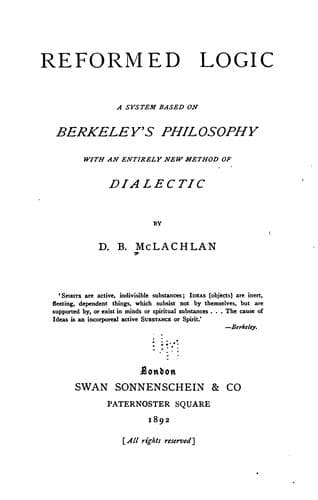
Reformed Logic: A System Based on Berkeley's Philosophy with an Entirely New Method of DialecticMcLachlan, D. B.
Philosophy
Reformed Logic: A System Based on Berkeley's Philosophy with an Entirely New Method of Dialectic
McLachlan, D. B.
Logic
From the moment we select a datum the remaining data are of no import
to us, and they need not be mentioned. The selection of one datum
is logically identical with the rejection of the rest, and this
is therefore not a conclusion from that.--'Do you take tea or
coffee?'--'Tea, please.'--'Then I conclude you do not take coffee.'--A
person who would 'conclude' in this fashion would be justly deemed
irrational. The choice of the tea is a fact, and the rejection of the
coffee is the same fact otherwise expressed, so that the rejection
cannot be a rational conclusion.--'My doctor sends me off every
winter to Nice, Algiers, or Egypt; but I never go to Algiers or
Egypt.'--There is no occasion to say, 'therefore you go to Nice'; that
has been already announced as a matter of fact and is not susceptible
of inference. For the sake of verbal emphasis we might remark, 'So it
is to Nice you go', but this is not logically requisite.
Whately's examples of this kind of theorem are exactly of the model
just given.--'Either the earth is eternal, or the work of chance, or
the work of an intelligent Being; it is not eternal, nor the work of
chance, _therefore_ it is the work of an intelligent Being.' This is
put forward in all gravity as a specimen of reasoning. It is plain
that if we know the premises as matters of fact, we also know the
proposed conclusion as a matter of fact. There is no occasion to
reason about it.
The Aristotelian hypothetical can be reduced to arithmetical
subtraction. Suppose we put five balls into a bag and afterwards take
out three without seeing the remainder: is the judgment that two balls
remain in the bag a logical inference? No--it is matter of fact. Since
we last perceived the objects they have undergone diminution, but that
does not confer on what is left of them the imaginary character proper
to a rational conclusion. What remains is as much fact--recollected
but not imaginary fact--as before the subtraction.
Whately's next example is--'It is either spring, summer, autumn, or
winter; but it is neither spring nor summer; therefore it is either
autumn or winter.' This is aggravated fallacy. Not only is it mere
subtraction, but the remainder is _perceived_--not recollected, as in
the preceding case. The actual season of the year is a known fact, and
is not rendered more certain by an inference drawn from the absence
of some other season. Arguments have no validity as against matters
of fact, and add nothing to their authority. Fact is above, and
independent of, argument. The example just cited may be paralleled
thus--'The cards in my hand are either spades, hearts, clubs,
or diamonds; but they are neither spades nor hearts; therefore
they are either clubs or diamonds'.--I _see_ that they are
either clubs or diamonds: the perceptual judgment renders the
rational--imaginary--judgment superfluous. Reason is intended to
supplement experience--not to supersede it.
XX--DEBATE
Public-domain text, read in full here on John Shaqi.
Reviews
Reviews
No reviews yet
Be the first to share your thoughts on this work.
Join the Discussion
Join the discussion
Sign in to leave a comment or review.
Sign InorCreate an account