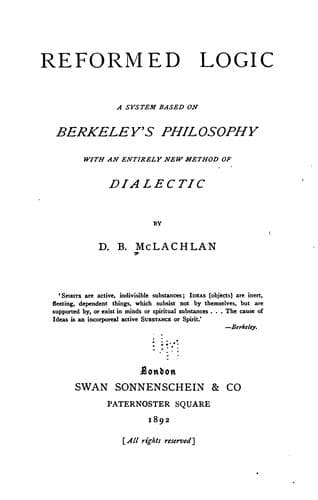
Reformed Logic: A System Based on Berkeley's Philosophy with an Entirely New Method of DialecticMcLachlan, D. B.
Philosophy
Reformed Logic: A System Based on Berkeley's Philosophy with an Entirely New Method of Dialectic
McLachlan, D. B.
Logic
The purpose of debate is to determine the goodness or badness of an
argument by general logical criticism and knowledge of the matter.
This is not dialectic, but takes place after the dialectician
has declared that a given theorem is valid argument. If then its
conclusion is repugnant to us we may seek to stigmatise it--or remove
a stigma as the case may be--by going behind the argument to the
composition of the judgments that enter into it.
Let us take the case of Caesar being proved to be a tyrant in a
society that punishes tyranny with death. There are two ways in which
he may be saved or his punishment mitigated.
We are not bound to take the first precedent that is offered from
which to generate a conclusion. We grant that Caesar resembles the
general notion 'tyrant,' but we ask if he does not resemble in an
equal or greater degree some other person or class in regard to
whom capital punishment is no just treatment. Does he resemble a
'successful and patriotic general'--a 'benevolent monarch'--a 'wise
legislator'--a 'virtuous man'? All these resemblances are compatible
with his being a tyrant in some senses of the word. Let us not condemn
Caesar for what may be a merely technical offence--the usurpation
of authority--if in other respects he is an admirable man. So an
opportunity must be given to Caesar or his advocate to suggest other
precedents, yielding a different conclusion, by which to complete our
imperfect knowledge of the case. Socrates, when he was brought under
the class 'perverters of youth'--which also yielded the conclusion
'death'--suggested as an amendment that he should be classed under
'national benefactors,' with the conclusion 'maintenance for life at
the public expense.'
It is not enough that we can say of a case that it 'is' this or that,
and so proceed to draw the conclusion bound up in that classification.
'Is' in the case means likeness to the precedent, and one 'is' is good
only when no better can be found.
If after having weighed the alternative precedents it appears clear
that Caesar resembles tyrants more than any other class of persons,
the prospect looks bad for him. But there is still a chance of
escaping the worst penalty. It turns on the meaning of the word
'all,' which in logic generally introduces a proposition to which no
exception has been found--the misnamed and misleading 'universal.'
Logicians do not hesitate to say that in this connection it means 'all
possible, known or unknown, past or future individuals of the class.'
They suppose, or talk as if they supposed, that at some fixed date in
our life we enter into possession of our general ideas, and that no
subsequent experience can modify them. Hence the moment it is admitted
that Caesar is a tyrant, he is supposed to come under the rule of a
stereotyped general idea with inflexible consequences.
Public-domain text, read in full here on John Shaqi.
Reviews
Reviews
No reviews yet
Be the first to share your thoughts on this work.
Join the Discussion
Join the discussion
Sign in to leave a comment or review.
Sign InorCreate an account