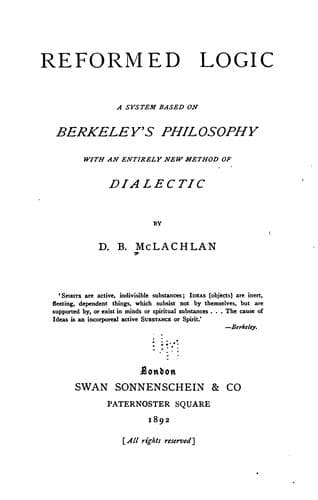
Reformed Logic: A System Based on Berkeley's Philosophy with an Entirely New Method of DialecticMcLachlan, D. B.
Philosophy
Reformed Logic: A System Based on Berkeley's Philosophy with an Entirely New Method of Dialectic
McLachlan, D. B.
Logic
This is not quite so. 'All' does not mean 'all possible' but
'all known up to the present time, _exclusive of the case under
discussion_.' Our general or average ideas are the plasmic product of
the individuals we have actually known--not a unit more. And as that
idea is liable to be modified by every new individual examined, it
is possible that on examining Caesar we may find reason to change our
general idea, to the extent at least of dividing it into two species,
the tyrants who deserve death and the tyrants who deserve some milder
punishment, and that we shall resolve to bring Caesar under the latter
species. Thus if the idea threatens to hang Caesar, on the other hand
Caesar may burst the idea, and his case establish itself as a new
precedent. That is how general ideas multiply--by a sort of fission.
In the proposition 'tyrants deserve death' as first proposed, we are
dealing with the old general idea, and--as regards all individuals
except those from which it was drawn--the proposition is little
more than a hypothesis. The idea is itself on trial. Until Caesar is
examined we do not fully know how the general tyrant is in future to
be defined. Our examination of Caesar is a part of our education on
the subject of tyrants. In judging we learn, and the general idea
which remains _after Caesar is examined_ is that by which he is to be
judged.
If our idea of tyrant remains unshaken after the trial of Caesar, and
if he is found to resemble that class more than any other, then--and
not till then--are we compelled to pass on him the judgment associated
with the definition of tyrant.
An argument based on a particular or solitary precedent is criticised
on the same principles. We seek to prove either that the case is not
sufficiently like the precedent to justify the application, or that
the applicate is not a property of the precedent. If we make good
either of these propositions, we prevent the suggested conclusion from
being fastened on the case.
Public-domain text, read in full here on John Shaqi.
Reviews
Reviews
No reviews yet
Be the first to share your thoughts on this work.
Join the Discussion
Join the discussion
Sign in to leave a comment or review.
Sign InorCreate an account