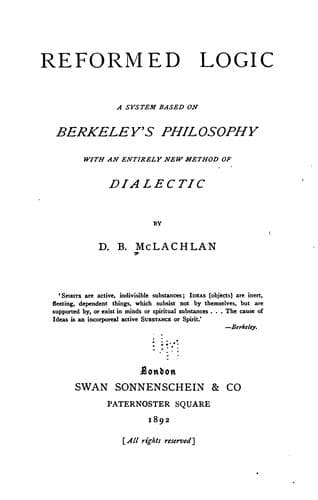
Reformed Logic: A System Based on Berkeley's Philosophy with an Entirely New Method of Dialectic — John Shaqi
Reformed Logic: A System Based on Berkeley's Philosophy with an Entirely New Method of DialecticMcLachlan, D. B.
Philosophy
Reformed Logic: A System Based on Berkeley's Philosophy with an Entirely New Method of Dialectic
McLachlan, D. B.
Logic
The syllogistic dialecticians do not admit alternative precedents
or reconstruction of general ideas: their terms and figures are not
adapted to express such notions. Hence they cannot evade a conclusion
whose premises are correctly given. They have an axiom to the effect
that a judgment must be absolutely true or absolutely false--a door
must be open or shut, it cannot be ajar; every colour is white
or black, it cannot be green or grey, and so on. Now in practical
reasoning we may and constantly do admit premises and reject the
conclusions they dialectically involve. We look at the question 'from
another point of view.' This means that while admitting there is some
ground for bringing a case under a certain precedent, we contend that
on the whole it is preferable to bring it under another precedent
with a different conclusion. The proposed handle _may_ fit the vase
somehow, but we think another sort of handle will suit it better.
Or--rather than accept an objectionable conclusion--we will divide our
idea. This is degree in truth. And that is the elastic method on which
we reason in actual affairs. Logicians give a false account of reason,
and so their systems are neglected and their authority is never
recognised in real debates.
CATEGORIES
XXI--CATEGORIES OF SUBSTANTIALISM, AND OTHERS
A Category is primarily a class of Judgments. Since arguments are
composed of judgments, a category is also a class of arguments; that
is to say, the argument follows the classification of the judgment.
This is not the practice of syllogists, who have categories for
judgments only, the arguments being classified according to verbal
expression.
I distinguish six categories--two Natural and four Artificial. The
judgments of a natural category concern experience presented in
a synthesis whose composition is due to the noumenal mind; the
categories corresponding to this definition are--
Inherence--
Association.
An artificial category is so called because the synthesis is formed by
the subjective mind.
The first category of this kind is
Perspection--
which is an artificial arrangement of objects according to a
figurative interpretation of certain appearances they present.
The second artificial category I will call
Concretion--
as it is an ideal cohesion of experiences never wholly perceived
at once. These two categories are those chiefly responsible for the
realistic mode of thought.
The third artificial category is that which is called in science
causation, but it is only
Sequence,--
that is, a series of phenomena sufficiently coherent to afford a basis
for inference, but not necessarily or energically connected. Hume and
others have conclusively proved that such phenomena are not causally
related.
Finally there is
Causation--
Public-domain text, read in full here on John Shaqi.
Reviews
Reviews
No reviews yet
Be the first to share your thoughts on this work.
Join the Discussion
Join the discussion
Sign in to leave a comment or review.
Sign InorCreate an account