Reformed Logic: A System Based on Berkeley's Philosophy with an Entirely New Method of Dialectic — John Shaqi
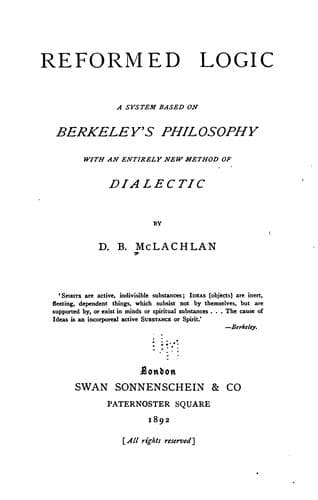
Reformed Logic: A System Based on Berkeley's Philosophy with an Entirely New Method of DialecticMcLachlan, D. B.
Philosophy
Reformed Logic: A System Based on Berkeley's Philosophy with an Entirely New Method of Dialectic
McLachlan, D. B.
Logic
in the proper sense of the word, that is, the relation between energic
mind and its effects. This is the category of human affairs generally,
and of all the Cosmic that we explain by analogy with the Human. It is
the only exhaustive explanation of phenomena, and so is the category
which philosophy would substitute for the rest. When we can truly
resolve things into effects analogous to human actions, we have
reached the highest standpoint from which they can be viewed.
_Realistic_ anthropomorphism is the first and rudest explanation of
things: _idealistic_ anthropomorphism is the last and most refined.
The artificial categories are all formed on analogies supplied by
the natural, since the intellect is incapable of imagining anything
absolutely original.
Each category may include judgments of other categories in a
subordinate relation. Inherence and concretion enter to some extent as
auxiliaries into all the others. A group category may be treated as an
individual object for certain purposes, and an individual as a group
of properties. In the one case a fictitious unity is created, in the
other a real unity is imaginatively dissolved. But in general the
categories are sufficiently distinct and may be considered as mutually
exclusive. They will be separately analysed and exemplified.
The term category is used in common logic to signify the final classes
into which _judgments_ can be arranged. To this minor use only is
the category applied. It does not either denote a classification of
_arguments_ or a distinct province of ideas whose origin and validity
should be a matter of investigation. In Greek and modern logic
arguments are distinguished solely by their verbal expression--never
by the character of the judgment that enters into them. Treated in
this superficial and haphazard way, the categories necessarily play a
quite insignificant part in philosophy.
The oldest known set of categories is that quoted by Aristotle in his
Metaphysic as being held by a sect of Pythagoreans. It consists of the
following series of contraries--
Bound. Infinity.
Odd. Even.
Unity. Plurality.
Right. Left.
Male. Female.
Rest. Motion.
Straight. Crooked.
Light. Darkness.
Good. Bad.
Square. Oblong.
Aristotle's own categories are the following:--
(1) _Essence_ or _Substance_, as man, horse:
(2) _Quantity_, as two cubits long:
(3) _Quality_, as white, erudite:
(4) _Relation_, as double, half, greater:
(5) _Place_, as in the Agora:
(6) _Time_, as yesterday:
(7) _Posture_, as standing, sitting:
(8) _Having_ (Condition?), as to be shod, armed:
(9) _Action_, as he is cutting, burning:
(10) _Passion_, as he is being cut.
Public-domain text, read in full here on John Shaqi.
Reviews
Reviews
No reviews yet
Be the first to share your thoughts on this work.
Join the Discussion
Join the discussion
Sign in to leave a comment or review.
Sign InorCreate an account