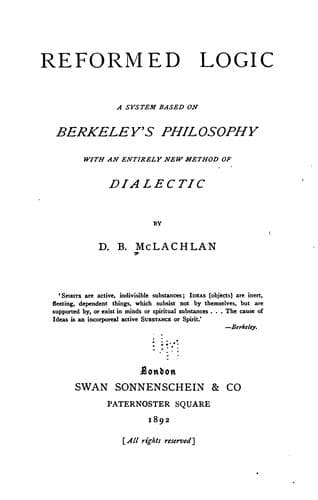
Reformed Logic: A System Based on Berkeley's Philosophy with an Entirely New Method of DialecticMcLachlan, D. B.
Philosophy
Reformed Logic: A System Based on Berkeley's Philosophy with an Entirely New Method of Dialectic
McLachlan, D. B.
Logic
This list can be reduced to one half the number. Quantity, Quality,
Posture, Condition are kinds of _Attribute_ or _Property_ of the
Substance. Place and Time are valid. Action and Passion are both
referable to causation. Non-causal sequence or consecution (as day
following night)--one of the commonest judgments--is not mentioned.
The Stoics reduced Aristotle's ten categories to four--Substratum or
Substance, the Essential Quality, Manner of being, and Relation.
Ka[n.]áda, a Hindu philosopher, has six categories--Substance,
Quality, Action, Genus, Individuality, and Concretion or Co-inherence.
Plotinus was acquainted with the Aristotelian and Stoic lists and
offers as his own:--(1) Fundamental forms of the _Ideal_--Being,
Rest, Motion, Identity, Difference; (2) Categories of the
_Sensible_--Substance, Relation, Quality, Quantity, Motion.
Descartes recognised but two final categories, the Absolute and the
Relative.
Kant has an elaborate scheme of categories, which he considered to be,
not merely classes of judgments, but innate power of the mind by which
we are moved to form the judgments. They are the following:--
I. _Of Quantity._ Unity, Plurality, Totality.
II. _Of Quality._ Reality, Negation, Limitation.
III. _Of Relation._ Of Inherence and Subsistence
(_substantia et accidens_).
Of Causality and Dependence
(cause and effect).
Of Community (reciprocity between
the active and the passive).
IV. _Of Modality._ Possibility, Impossibility, Existence,
Non-existence, Necessity,
Contingency.
Sir William Hamilton's categories were Being, Being by itself, and
Being by accident.
Categories have also been proposed by Spinoza, Locke, Wolff, Leibnitz,
Herbart, Mill, and others. No two of them are alike. They are not
formed on any definite principle, but are individual opinions as to
the most convenient way to classify judgments[13].
XXII--INHERENCE
An object being given by perception we develop our knowledge of it,
first by narrowing our focus of attention so as to perceive parts and
single attributes of the object; next by widening our attention so as
to include several objects in one view. The first process is Analysis
or Abstraction; it informs us what attributes co-inhere to constitute
the object. The second is Synthesis or Grouping, by which we learn
the relations of one thing to others. These operations comprise all we
know about a thing, for it can have no attributes which are not either
internal or external.
Public-domain text, read in full here on John Shaqi.
Reviews
Reviews
No reviews yet
Be the first to share your thoughts on this work.
Join the Discussion
Join the discussion
Sign in to leave a comment or review.
Sign InorCreate an account