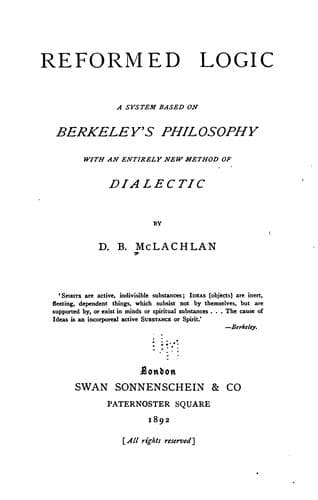
Reformed Logic: A System Based on Berkeley's Philosophy with an Entirely New Method of DialecticMcLachlan, D. B.
Philosophy
Reformed Logic: A System Based on Berkeley's Philosophy with an Entirely New Method of Dialectic
McLachlan, D. B.
Logic
XXXIX Additional examples to illustrate the
Dialectic of Substantialism 205
INTRODUCTION
I--RELATION OF BERKELEY'S PHILOSOPHY TO OTHER SYSTEMS
Philosophies are either Ideal or Substantial. The ideal are those
which resolve all things, actual and possible, into thought or
consciousness. They seek to find in consciousness the reason and
meaning of itself, or, if this be impossible, to account for each item
in consciousness by defining its relation to some other item, or to
some general mass of consciousness. This type of philosophy includes
German transcendentalism and idealism, and some species of Buddhist
and Persian metaphysic. European idealists are seldom consistent, for
at the basis of their philosophies (or at the apex) they place GOD,
who is not an item of human consciousness, actual or potential, and
who therefore occupies, whether it be admitted or not, the relation of
substance to human thought.
Substantial philosophies affirm that thought invariably inheres in
some sort of Substance, for whose service it exists. It is incapable
of independent being, and cannot be understood abstracted from its
substance. It is intermittent, called up when wanted, and is liable to
variation and aberration.
Substantialists differ however as to what the substance of human
intelligence is. Some hold that it is the human body. Consciousness
exists, they argue, for the use of the body and varies with its
condition. This class of philosophers may be subdivided into
Materialists and Metaphysicians (including logicians).
Materialists believe that consciousness is a product of the physical
body--has therefore no existence before the body is formed or after it
is dissolved. It is really as physical as the teeth or hair.
In metaphysic the intelligence is supposed to have a principle of
existence apart from the body, and does not, or need not, share the
fate of the body. The body is nevertheless regarded as the substance
or superior fact during the union of the two. This is an eminently
inconsistent philosophy, for if consciousness has an existence apart
from body it must be in some other substance, and if so its relations
to that substance are more important than its relations to the body,
and should be the first object of inquiry. Metaphysic is in its
development an idealism, since the connection admitted between body
and thought is too slight to afford a sufficient explanation of
intelligence, and no other substantial relation is known.
The notion that an invisible immaterial substance may underlie
consciousness has occurred to some philosophers, among others to
the illustrious BERKELEY. His theory of Vision, which has never been
refuted or even weakened, is founded on this hypothesis.
Public-domain text, read in full here on John Shaqi.
Reviews
Reviews
No reviews yet
Be the first to share your thoughts on this work.
Join the Discussion
Join the discussion
Sign in to leave a comment or review.
Sign InorCreate an account