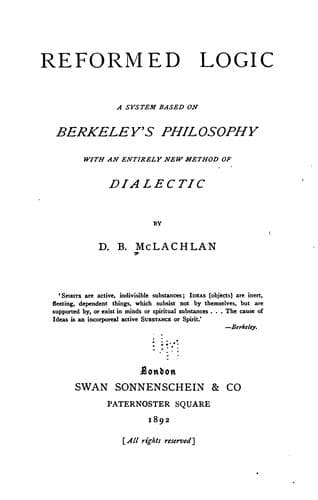
Reformed Logic: A System Based on Berkeley's Philosophy with an Entirely New Method of Dialectic — John Shaqi
Reformed Logic: A System Based on Berkeley's Philosophy with an Entirely New Method of DialecticMcLachlan, D. B.
Philosophy
Reformed Logic: A System Based on Berkeley's Philosophy with an Entirely New Method of Dialectic
McLachlan, D. B.
Logic
Berkeleyan substantialism combines the characteristic features of
the other theories, and affords an easy solution of many difficult
problems in philosophy. It has in common with idealism--whence it is
sometimes, but erroneously, called by that name--that it regards all
_material_ bodies and things as facts or items of consciousness.
It agrees with materialism that a substance is essential to
consciousness, and that the consciousness of man serves the needs of
his body, though that is not the highest use to which it can be put.
It confirms the metaphysical view that intelligence is not, in its
abstract or essential character, dependent on the body, and may
therefore survive the body.
This is the theory on which the following logic is based: I shall
refer to it briefly as Substantialism.
II--ONTOLOGICAL NOTIONS
Substantialism has two main divisions--Ontology, which treats of the
mental substance in itself, and Logic or Metaphysic, which deals
with its consciousness. The present essay is specially concerned with
logic, but certain ontological premises must be assumed to render
the logic intelligible. This follows from the subordinate relation of
consciousness to substance.
The substantial mind consists of two principal parts--a SELF and a
PLASMA--the Atman and Aka['s]a of Sanscrit philosophers.
Self is the seat of Energy and Consciousness. The plasma is inert
and unconscious; it protects the Self and receives, communicates,
and retains impressions of experience, both the external and the
internal[1].
The Self would be conscious though isolated from other minds, at least
from those of its own grade of being. It would feel the fluctuations
of its energy. But the experience called 'external' depends on the
mutual action of minds. It is the form into which their consciousness
is thrown when they come in contact. It lasts no longer than the
contact, and so has only a casual existence.
The constitution of the mind is not given by Berkeley, and on other
points also we must supplement and correct his philosophy. He was
wrong as regards the mental cause of the perception of the Inorganic
or Dead.
Since external experience implies that another mind is operating
upon ours, what mind is operating when we perceive an object that is
apparently mindless? Berkeley replies that it is the supreme mind that
is then acting upon us.
Many objections can be urged against this view. I will mention only
one, which seems to me conclusive. By every canon of judgment we
possess, the living or organised is better--more important and
significant--than the lifeless and elemental; so if Berkeley's
reasoning be valid the phenomena excited by finite and created beings
are superior to those excited by their Creator. The movements of a
living man are referred to a human mind--a putrescent carcase is a
vision immediately induced by the Deity.
Public-domain text, read in full here on John Shaqi.
Reviews
Reviews
No reviews yet
Be the first to share your thoughts on this work.
Join the Discussion
Join the discussion
Sign in to leave a comment or review.
Sign InorCreate an account