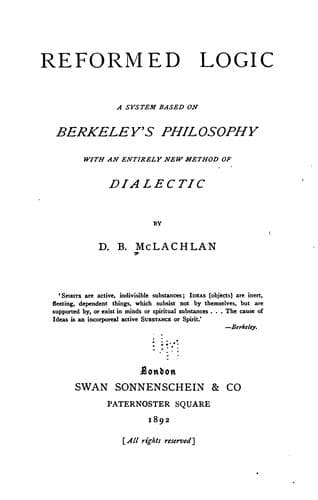
Reformed Logic: A System Based on Berkeley's Philosophy with an Entirely New Method of DialecticMcLachlan, D. B.
Philosophy
Reformed Logic: A System Based on Berkeley's Philosophy with an Entirely New Method of Dialectic
McLachlan, D. B.
Logic
Practical analysis means cutting a thing to pieces or dissolving it,
and this has a certain value because it multiplies objects. But it
does not increase our knowledge of the first thing. On the contrary,
by destroying a thing we render a knowledge of it impossible. The
analysis which gives knowledge is Metaphysical Abstraction--an
attention concentrated on the parts of a thing without destroying
their connection with the other inherent parts. The metaphysical
elements may be quite different from the mechanically divisible parts.
They are generally a species of things which could not exist alone,
such as red, blue, straight, curved, square, round, acid, sweet,
insipid, fragrant, sharp, hot, heavy, dull, loud, bright, and a
multitude of properties of that abstract kind.
For many of these--at least for the description of them--a comparison
of two or more things is essential. A sound is heard to be loud by
comparison with another which is low or soft; a knife is known to
be blunt by experience of another more sharp, or the same knife in
a sharper condition. But comparison does not alter the essential
character of abstract attention--it serves merely as an incitement to
it. Difference between qualities otherwise alike whets our attention
to a finer discrimination.
The properties recognised by each sense are easily distinguished in
the bulk from those of another sense. Colour is distinct from Figure
in a more marked degree than red from blue or square from circular.
Fine degrees of Sound may be difficult to discriminate, but not the
difference between a sound and a smell or a taste.
Still broader contrasts give rise to an artificial but sometimes
useful kind of attribution--the negative. When we do not know much
concerning the positive characteristics of a thing, it is something
to know that it has _not_ this or that property. What Thought is,
positively, few people know, but they are able to say (with a little
prompting) that it is un-extended, im-material, im-ponderable, and so
forth. This comparison re-acts on the thing better known, and so we
call visual objects 'extended' from their dissimilarity to thoughts.
But for that there would have been no occasion to notice the abstract
extension of visual objects. The term 'visual object' would have
tacitly included extension. There must be great and general ignorance
of a thing to excuse the negative attribution: it is not allowable
to speak of plants as non-metals, or sheep as non-horses, but a large
class of animals is called in-vertebrate. In this case the negative
property serves to bar a possible inference that all animals are
vertebrate, since those we know best are so.
Public-domain text, read in full here on John Shaqi.
Reviews
Reviews
No reviews yet
Be the first to share your thoughts on this work.
Join the Discussion
Join the discussion
Sign in to leave a comment or review.
Sign InorCreate an account