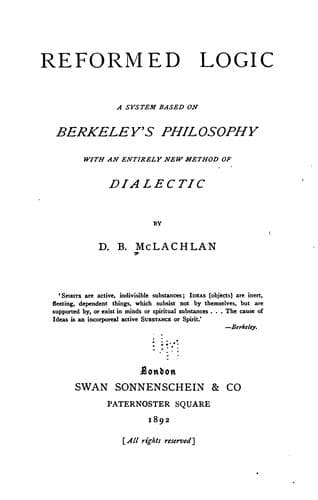
Reformed Logic: A System Based on Berkeley's Philosophy with an Entirely New Method of DialecticMcLachlan, D. B.
Philosophy
Reformed Logic: A System Based on Berkeley's Philosophy with an Entirely New Method of Dialectic
McLachlan, D. B.
Logic
The judgment in this category is a consciousness of the attributes
making up a thing, or so much of it as interests us. 'Cleopatra's
Needle is an obelisk of granite, about sixty-eight feet high, and is
carved with hieroglyphics.' If we go on to say that it stands on the
Thames Embankment, we shift into the category of association. The
relation of an object to its place is different from that of one
inherent attribute of the object to another, or to the whole.
The properties of a general idea are defined in this category. The
synthesis is natural or noumenal, the artificiality of the idea
consisting merely in the omission of some of the concrete properties.
'Garden rhubarb [in general] has broadly cordate leaves, strongly
veined beneath; the footstalks are long, thick, and fleshy, with a
channel above; its growth is exceedingly rapid.' These are properties
inherent in a unity not of our making. The botanist changes into the
category of sequence when he says, 'the stalks are used for tarts and
made into jam.'
In a complicated object or general idea some of the judgments we treat
as inherent may be inferences in other categories used subordinately.
'The ancient Persians had remarkably thin and weak skulls. They were
good horsemen and archers, courageous and spirited in battle. They
wore a tunic and trousers of leather.... They were quick and
lively, keen-witted, capable of repartee, ingenious, and--for
Orientals--far-sighted. They had fancy and imagination, a relish for
poetry and art, and they were not without a certain power of political
combination.' Some of these properties might have been perceived
objectively, but not the possession of fancy and imagination, which
could only be known by inference in causation--here used to complete
a coherent unity. The historian employs causation as a principal
category when he tells us that 'their bards did not touch the chords
which rouse what is noblest and highest in our nature.' The thought
implied in touching chords--the notion of will directing action--is
a different judgment from the perception of an inherent permanent
attribute.
The argument in this category consists in ideally completing an
imperfect object by comparison with a similar object, or the idea of a
similar object. Suppose we have studied thoroughly one or more rhubarb
plants, and then see a plant with broadly cordate leaves, footstalks
long, thick, and fleshy, and having a channel above. In the time at
our disposal we cannot ascertain if its growth is exceedingly rapid,
but we are justified in inferring that it is, and that the plant
we are examining is in all other respects rhubarb. If the Egyptian
obelisks we have seen were sculptured with hieroglyphics throughout
their length, and we see an obelisk part of which is underground, it
is a rational inference that that part also is sculptured.
Public-domain text, read in full here on John Shaqi.
Reviews
Reviews
No reviews yet
Be the first to share your thoughts on this work.
Join the Discussion
Join the discussion
Sign in to leave a comment or review.
Sign InorCreate an account