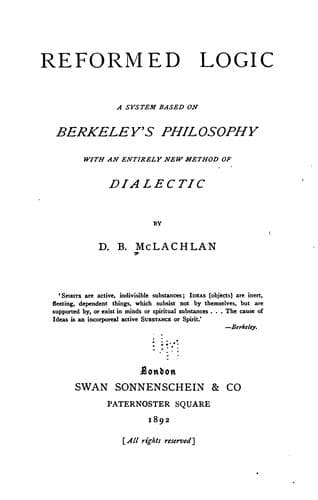
Reformed Logic: A System Based on Berkeley's Philosophy with an Entirely New Method of DialecticMcLachlan, D. B.
Philosophy
Reformed Logic: A System Based on Berkeley's Philosophy with an Entirely New Method of Dialectic
McLachlan, D. B.
Logic
We have proved that certain samples of aluminium have a specific
gravity of 2·6, and then see a metal--of specific gravity
unknown--which has all the other properties of aluminium: we may
confidently infer that this metal also would, if tested, show a
specific gravity of 2·6.
For purposes of reason it may be necessary to compare things that
cannot be brought physically together. When this happens we generally
compare them in _idea_, or the idea of one with the other as object.
When great accuracy is required and the idea--which is always rather
vague--cannot be relied on, we have recourse to mediate comparison.
_Standards_ are employed. These are manageable or portable objects
with which principal things are separately compared by way of
effecting indirectly a comparison between them. Standards can only
mediate comparisons between _abstract_ properties, for if they
contained all the concrete properties of the compared objects they
would, by supposition, be as unmanageable as the latter. We have
standards for length in rules, scales, tapes, chains; the balance is
a standard for weight. There are also scales for pitch of sound,
varieties of colour, degree of light, heat, atmospheric pressure, and
probably some others for special purposes.
Indirect comparison is not in itself inference; or if inference it is
subordinate and preparatory to some more important conclusion. A coin
is weighed and concluded to be _light_, but this is only a datum in
determining the more important question whether it is a forged coin or
not.
XXIII--ASSOCIATION
In this category we widen the attention so as to include several
objects in one act of perception.
The first result of this diffusion of attention is to lessen the
brilliancy of objects. Our attention is a light which is intensified
when narrowed and concentrated--enfeebled when dispersed over several
objects. The observation of a group amounts practically to observing
the objects in rapid succession. At a given moment we perceive only
one thing well, or it may be only a small part of a thing, but we have
a dull sense of other things adjacent, which we have just seen and
may immediately see again in any order we please. That is all that is
meant by perception of a group.
To distinguish this category properly from the next we must consider
the group of objects as divested of depth or distance outwards. It
is to be regarded as a flat surface standing a few feet from us, the
objects in it having absolutely the dimensions they appear to
have. This is in fact their _real_ magnitude, for the supposed real
magnitude is a matter of theory, and means the perceptual magnitude
taken under certain conditions of observation. The real magnitude is
constantly changing, so for practical convenience in determining size,
etc., we refer all objects to one condition of observation--that in
which they can be touched as well as seen.
Public-domain text, read in full here on John Shaqi.
Reviews
Reviews
No reviews yet
Be the first to share your thoughts on this work.
Join the Discussion
Join the discussion
Sign in to leave a comment or review.
Sign InorCreate an account