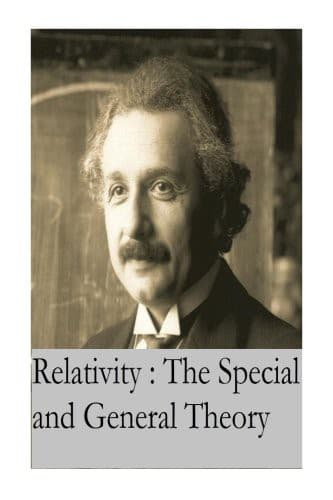
Relativity: The Special and General TheoryEinstein, Albert
Science
Relativity: The Special and General Theory
Einstein, Albert
Relativity (Physics)
If we desire to adhere to our “old-time” three-dimensional view of
things, then we can characterise the development which is being
undergone by the fundamental idea of the general theory of relativity
as follows: The special theory of relativity has reference to Galileian
domains, _i.e._ to those in which no gravitational field exists. In
this connection a Galileian reference-body serves as body of reference,
_i.e._ a rigid body the state of motion of which is so chosen that the
Galileian law of the uniform rectilinear motion of “isolated” material
points holds relatively to it.
Certain considerations suggest that we should refer the same Galileian
domains to _non-Galileian_ reference-bodies also. A gravitational field
of a special kind is then present with respect to these bodies (cf.
Sections XX and XXIII).
In gravitational fields there are no such things as rigid bodies with
Euclidean properties; thus the fictitious rigid body of reference is of
no avail in the general theory of relativity. The motion of clocks is
also influenced by gravitational fields, and in such a way that a
physical definition of time which is made directly with the aid of
clocks has by no means the same degree of plausibility as in the
special theory of relativity.
For this reason non-rigid reference-bodies are used, which are as a
whole not only moving in any way whatsoever, but which also suffer
alterations in form _ad lib._ during their motion. Clocks, for which
the law of motion is of any kind, however irregular, serve for the
definition of time. We have to imagine each of these clocks fixed at a
point on the non-rigid reference-body. These clocks satisfy only the
one condition, that the “readings” which are observed simultaneously on
adjacent clocks (in space) differ from each other by an indefinitely
small amount. This non-rigid reference-body, which might appropriately
be termed a “reference-mollusc”, is in the main equivalent to a
Gaussian four-dimensional co-ordinate system chosen arbitrarily. That
which gives the “mollusc” a certain comprehensibility as compared with
the Gauss co-ordinate system is the (really unjustified) formal
retention of the separate existence of the
space co-ordinates as opposed to the time co-ordinate. Every point on
the mollusc is treated as a space-point, and every material point which
is at rest relatively to it as at rest, so long as the mollusc is
considered as reference-body. The general principle of relativity
requires that all these molluscs can be used as reference-bodies with
equal right and equal success in the formulation of the general laws of
nature; the laws themselves must be quite independent of the choice of
mollusc.
The great power possessed by the general principle of relativity lies
in the comprehensive limitation which is imposed on the laws of nature
in consequence of what we have seen above.
XXIX.
THE SOLUTION OF THE PROBLEM OF GRAVITATION ON THE BASIS OF THE GENERAL
PRINCIPLE OF RELATIVITY
Public-domain text, read in full here on John Shaqi.
Reviews
Reviews
No reviews yet
Be the first to share your thoughts on this work.
Join the Discussion
Join the discussion
Sign in to leave a comment or review.
Sign InorCreate an account