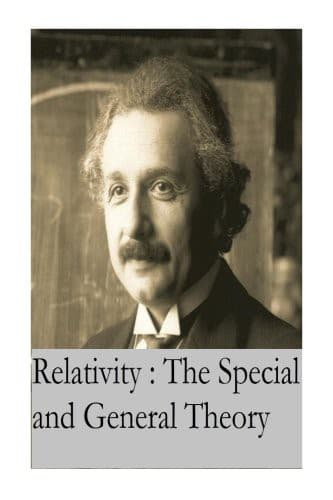
Relativity: The Special and General TheoryEinstein, Albert
Science
Relativity: The Special and General Theory
Einstein, Albert
Relativity (Physics)
If the reader has followed all our previous considerations, he will
have no further difficulty in understanding the methods leading to the
solution of the problem of gravitation.
We start off on a consideration of a Galileian domain, _i.e._ a domain
in which there is no gravitational field relative to the Galileian
reference-body _K_. The behaviour of measuring-rods and clocks with
reference to _K_ is known from the special theory of relativity,
likewise the behaviour of “isolated” material points; the latter move
uniformly and in straight lines.
Now let us refer this domain to a random Gauss coordinate system or to
a “mollusc” as reference-body _K′_. Then with respect to _K′_ there is
a gravitational field _G_ (of a particular kind). We learn the
behaviour of measuring-rods and clocks and also of freely-moving
material points with reference to _K′_ simply by mathematical
transformation. We interpret this behaviour as the behaviour of
measuring-rods, clocks and material points under the influence of the
gravitational field _G_. Hereupon we introduce a hypothesis: that the
influence of the gravitational field on measuring-rods, clocks and
freely-moving material points continues to take place according to the
same laws, even in the case where the prevailing gravitational field is
_not_ derivable from the Galileian special case, simply by means of a
transformation of co-ordinates.
The next step is to investigate the space-time behaviour of the
gravitational field _G_, which was derived from the Galileian special
case simply by transformation of the coordinates. This behaviour is
formulated in a law, which is always valid, no matter how the
reference-body (mollusc) used in the description may be chosen.
This law is not yet the _general_ law of the gravitational field, since
the gravitational field under consideration is of a special kind. In
order to find out the general law-of-field of gravitation we still
require to obtain a generalisation of the law as found above. This can
be obtained without caprice, however, by taking into consideration the
following demands:
(_a_) The required generalisation must likewise satisfy the general
postulate of relativity.
(_b_) If there is any matter in the domain under consideration, only
its inertial mass, and thus according to Section XV only its energy is
of importance for its effect in exciting a field.
(_c_) Gravitational field and matter together must satisfy the law of
the conservation of energy (and of impulse).
Finally, the general principle of relativity permits us to determine
the influence of the gravitational field on the course of all those
processes which take place according to known laws when a gravitational
field is absent _i.e._ which have already been fitted into the frame of
the special theory of relativity. In this connection we proceed in
principle according to the method which has already been explained for
measuring-rods, clocks and freely moving material points.
Public-domain text, read in full here on John Shaqi.
Reviews
Reviews
No reviews yet
Be the first to share your thoughts on this work.
Join the Discussion
Join the discussion
Sign in to leave a comment or review.
Sign InorCreate an account