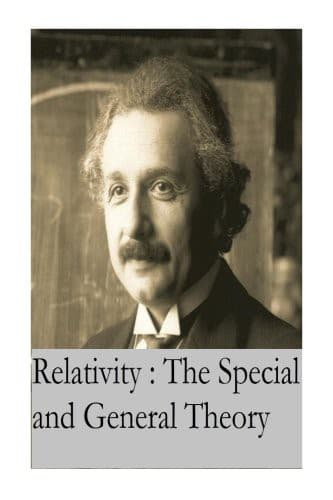
Relativity: The Special and General TheoryEinstein, Albert
Science
Relativity: The Special and General Theory
Einstein, Albert
Relativity (Physics)
The theory of gravitation derived in this way from the general
postulate of relativity excels not only in its beauty; nor in removing
the defect attaching to classical mechanics which was brought to light
in Section XXI; nor in interpreting the empirical law of the equality
of inertial and gravitational mass; but it has also already explained a
result of observation in astronomy, against which classical mechanics
is powerless.
If we confine the application of the theory to the case where the
gravitational fields can be regarded as being weak, and in which all
masses move with respect to the coordinate system with velocities which
are small compared with the velocity of light, we then obtain as a
first approximation the Newtonian theory. Thus the latter theory is
obtained here without any particular assumption, whereas Newton had to
introduce the hypothesis that the force of attraction between mutually
attracting material points is inversely proportional to the square of
the distance between them. If we increase the accuracy of the
calculation, deviations from the theory of Newton make their
appearance, practically all of which must nevertheless escape the test
of observation owing to their smallness.
We must draw attention here to one of these deviations. According to
Newton’s theory, a planet moves round the sun in an ellipse, which
would permanently maintain its position with respect to the fixed
stars, if we could disregard the motion of the fixed stars themselves
and the action of the other planets under consideration. Thus, if we
correct the observed motion of the planets for these two influences,
and if Newton’s theory be strictly correct, we ought to obtain for the
orbit of the planet an ellipse, which is fixed with reference to the
fixed stars. This deduction, which can be tested with great accuracy,
has been confirmed for all the planets save one, with the precision
that is capable of being obtained by the delicacy of observation
attainable at the present time. The sole exception is Mercury, the
planet which lies nearest the sun. Since the time of Leverrier, it has
been known that the ellipse corresponding to the orbit of Mercury,
after it has been corrected for the influences mentioned above, is not
stationary with respect to the fixed stars, but that it rotates
exceedingly slowly in the plane of the orbit and in the sense of the
orbital motion. The value obtained for this rotary movement of the
orbital ellipse was 43 seconds of arc per century, an amount ensured to
be correct to within a few seconds of arc. This effect can be explained
by means of classical mechanics only on the assumption of hypotheses
which have little probability, and which were devised solely for this
purponse.
Public-domain text, read in full here on John Shaqi.
Reviews
Reviews
No reviews yet
Be the first to share your thoughts on this work.
Join the Discussion
Join the discussion
Sign in to leave a comment or review.
Sign InorCreate an account