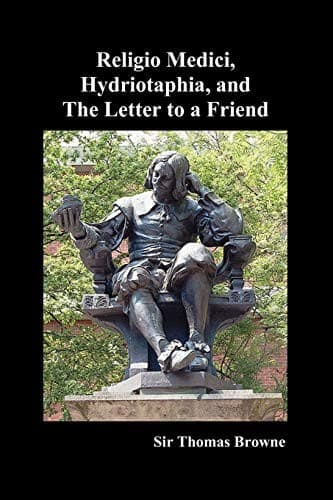
Religio Medici, Hydriotaphia, and the Letter to a Friend — John Shaqi
Religio Medici, Hydriotaphia, and the Letter to a FriendBrowne, Thomas, Sir
Religion
Religio Medici, Hydriotaphia, and the Letter to a Friend
Browne, Thomas, Sir
Christian ethics; Christian life; Essays; Funeral rites and ceremonies; Medical ethics; Medicine -- History; Religion and medicine
It is the method of charity to suffer without reaction: those
usual satires and invectives of the pulpit may perchance produce a good
effect on the vulgar, whose ears are opener to rhetoric than logic; yet
do they, in no wise, confirm the faith of wiser believers, who know
that a good cause needs not be pardoned by passion, but can sustain
itself upon a temperate dispute.
_Sect._ 6.--I could never divide myself from any man upon the
difference of an opinion, or be angry with his judgment for not
agreeing with me in that from which, perhaps, within a few days, I
should dissent myself. I have no genius to disputes in religion:
and have often thought it wisdom to decline them, especially upon a
disadvantage, or when the cause of truth might suffer in the weakness
of my patronage. Where we desire to be informed, ’tis good to contest
with men above ourselves; but, to confirm and establish our opinions,
’tis best to argue with judgments below our own, that the frequent
spoils and victories over their reasons may settle in ourselves an
esteem and confirmed opinion of our own. Every man is not a proper
champion for truth, nor fit to take up the gauntlet in the cause of
verity; many, from the ignorance of these maxims, and an inconsiderate
zeal unto truth, have too rashly charged the troops of error and
remain as trophies unto the enemies of truth. A man may be in as just
possession of truth as of a city, and yet be forced to surrender; ’tis
therefore far better to enjoy her with peace than to hazard her on a
battle. If, therefore, there rise any doubts in my way, I do forget
them, or at least defer them, till my better settled judgment and
more manly reason be able to resolve them; for I perceive every man’s
own reason is his best Œdipus,[7] and will, upon a reasonable truce,
find a way to loose those bonds wherewith the subtleties of error
have enchained our more flexible and tender judgments. In philosophy,
where truth seems double-faced, there is no man more paradoxical than
myself: but in divinity I love to keep the road; and, though not in an
implicit, yet an humble faith, follow the great wheel of the church,
by which I move; not reserving any proper poles, or motion from the
epicycle of my own brain. By this means I have no gap for heresy,
schisms, or errors, of which at present, I hope I shall not injure
truth to say, I have no taint or tincture. I must confess my greener
studies have been polluted with two or three; not any begotten in the
latter centuries, but old and obsolete, such as could never have been
revived but by such extravagant and irregular heads as mine. For,
indeed, heresies perish not with their authors; but, like the river
Arethusa,[8] though they lose their currents in one place, they rise
up again in another. One general council is not able to extirpate one
single heresy: it may be cancelled for the present; but revolution
of time, and the like aspects from heaven, will restore it, when it
Public-domain text, read in full here on John Shaqi.
Reviews
Reviews
No reviews yet
Be the first to share your thoughts on this work.
Join the Discussion
Join the discussion
Sign in to leave a comment or review.
Sign InorCreate an account