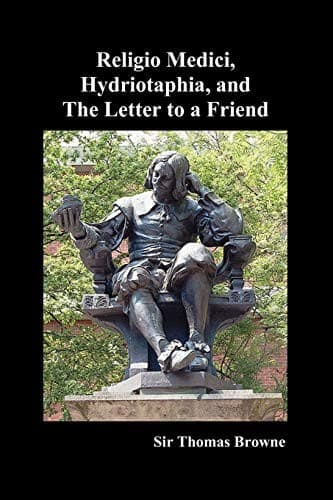
Religio Medici, Hydriotaphia, and the Letter to a FriendBrowne, Thomas, Sir
Religion
Religio Medici, Hydriotaphia, and the Letter to a Friend
Browne, Thomas, Sir
Christian ethics; Christian life; Essays; Funeral rites and ceremonies; Medical ethics; Medicine -- History; Religion and medicine
the face of truth, and those unstable judgments that cannot resist in
the narrow point and centre of virtue without a reel or stagger to the
circumference.
[A] A church-bell, that tolls every day at six and twelve of the clock;
at the hearing whereof every one, in what place soever, either of house
or street, betakes himself to his prayer, which is commonly directed to
the Virgin.
_Sect._ 4.--As there were many reformers, so likewise many
reformations; every country proceeding in a particular way and
method, according as their national interest, together with their
constitution and clime, inclined them: some angrily and with
extremity; others calmly and with mediocrity, not rending, but easily
dividing, the community, and leaving an honest possibility of a
reconciliation;--which, though peaceable spirits do desire, and may
conceive that revolution of time and the mercies of God may effect,
yet that judgment that shall consider the present antipathies between
the two extremes,--their contrarieties in condition, affection, and
opinion,--may, with the same hopes, expect a union in the poles of
heaven.
_Sect._ 5.--But, to difference myself nearer, and draw into a
lesser circle; there is no church whose every part so squares unto
my conscience, whose articles, constitutions, and customs, seem so
consonant unto reason, and, as it were, framed to my particular
devotion, as this whereof I hold my belief--the Church of England;
to whose faith I am a sworn subject, and therefore, in a double
obligation, subscribe unto her articles, and endeavour to observe her
constitutions: whatsoever is beyond, as points indifferent, I observe,
according to the rules of my private reason, or the humour and fashion
of my devotion; neither believing this because Luther affirmed it,
nor disproving that because Calvin hath disavouched it. I condemn
not all things in the council of Trent, nor approve all in the synod
of Dort.[3] In brief, where the Scripture is silent, the church is
my text; where that speaks, ’tis but my comment;[4] where there is a
joint silence of both, I borrow not the rules of my religion from Rome
or Geneva, but from the dictates of my own reason. It is an unjust
scandal of our adversaries, and a gross error in ourselves, to compute
the nativity of our religion from Henry the Eighth; who, though he
rejected the Pope, refused not the faith of Rome,[5] and effected no
more than what his own predecessors desired and essayed in ages past,
and it was conceived the state of Venice would have attempted in our
days.[6] It is as uncharitable a point in us to fall upon those popular
scurrilities and opprobrious scoffs of the Bishop of Rome, to whom, as
a temporal prince, we owe the duty of good language. I confess there is
a cause of passion between us: by his sentence I stand excommunicated;
heretic is the best language he affords me: yet can no ear witness I
ever returned to him the name of antichrist, man of sin, or whore of
Babylon.
Public-domain text, read in full here on John Shaqi.
Reviews
Reviews
No reviews yet
Be the first to share your thoughts on this work.
Join the Discussion
Join the discussion
Sign in to leave a comment or review.
Sign InorCreate an account