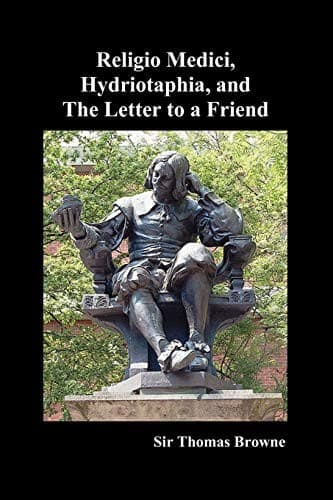
Religio Medici, Hydriotaphia, and the Letter to a FriendBrowne, Thomas, Sir
Religion
Religio Medici, Hydriotaphia, and the Letter to a Friend
Browne, Thomas, Sir
Christian ethics; Christian life; Essays; Funeral rites and ceremonies; Medical ethics; Medicine -- History; Religion and medicine
Browne had always been a Royalist. In 1643 he had refused to subscribe
to the fund that was then being raised for regaining Newcastle. He
proved a happy exception to the almost proverbial neglect the Royalists
received from Charles II. in 1671, for when Charles was at Newmarket,
he came over to see Norwich, and conferred the honour of knighthood
on Browne. His reputation was now very great. Evelyn paid a visit to
Norwich for the express purpose of seeing him; and at length, on his
76th birthday (19th October 1682), he died, full of years and honours.
It was a striking coincidence that he who in his Letter to a Friend
had said that “in persons who outlive many years, and when there are
no less than 365 days to determine their lives in every year, that
the first day should mark the last, that the tail of the snake should
return into its mouth precisely at that time, and that they should wind
up upon the day of their nativity, is indeed a remarkable coincidence,
which, though astrology hath taken witty pains to solve, yet hath it
been very wary in making predictions of it,” should himself die on the
day of his birth.
Browne was buried in the church of St Peter, Mancroft, Norwich, where
his wife erected to his memory a mural monument, on which was placed
an English and Latin inscription, setting forth that he was the author
of “Religio Medici,” “Pseudodoxia Epidemica,” and other learned works
“per orbem notissimus.” Yet his sleep was not to be undisturbed; his
skull was fated to adorn a museum! In 1840, while some workmen were
digging a vault in the chancel of St Peter’s, they found a coffin with
an inscription--
“Amplissimus Vir
D^{us} Thomas Browne Miles Medicinæ
D^r Annis Natus 77 Denatus 19 Die
Mensis Octobris Anno D^{nj} 1682 hoc.
Loculo indormiens Corporis Spagyrici
pulvere plumbum in aurum
convertit.”
The translation of this inscription raised a storm over his ashes,
which Browne would have enjoyed partaking in, the word _spagyricus_
being an enigma to scholars. Mr Firth of Norwich (whose translation
seems the best) thus renders the inscription:--
“The very distinguished man, Sir Thomas Browne, Knight, Doctor of
Medicine, aged 77 years, who died on the 19th of October, in the year
of our Lord 1682, sleeping in this coffin of lead, by the dust of his
alchemic body, transmutes it into a coffer of gold.”
After Sir Thomas’s death, two collections of his works were published,
one by Archbishop Tenison, and the other in 1772. They contain most
of his letters, his tracts on various subjects, and his Letter to a
Friend. Various editions of parts of Browne’s works have from time to
time appeared. By far the best edition of the whole of them is that
published by Simon Wilkin.
Public-domain text, read in full here on John Shaqi.
Reviews
Reviews
No reviews yet
Be the first to share your thoughts on this work.
Join the Discussion
Join the discussion
Sign in to leave a comment or review.
Sign InorCreate an account